
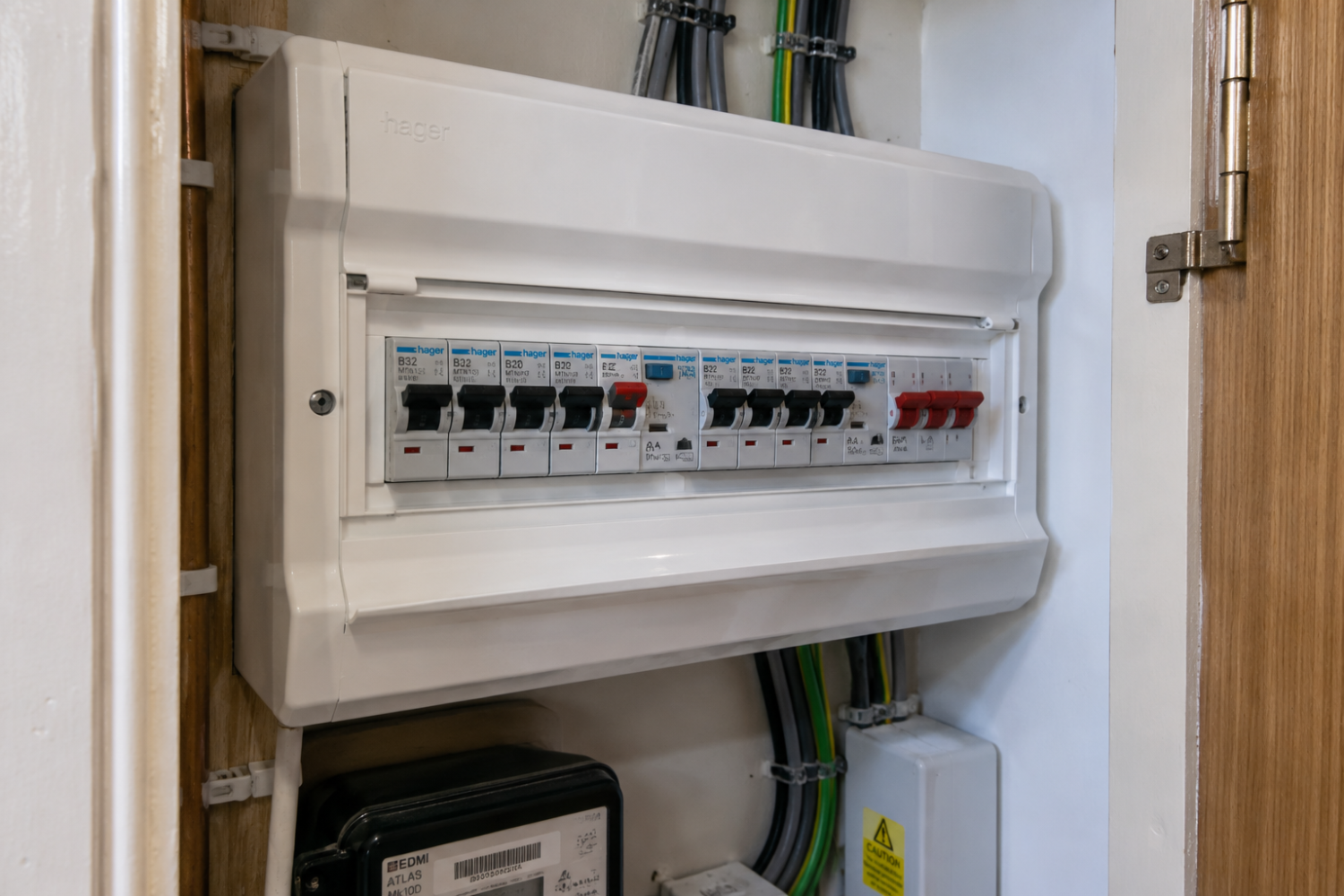
If your RCD keeps tripping, it usually means the device has detected an electrical fault or imbalance and has disconnected the electricity as a safety measure. The cause could be a faulty appliance, damaged wiring, moisture, an outdoor electrical fault or a problem somewhere within the fixed electrical installation.
An occasional trip does not automatically mean your home needs rewiring or that the RCD itself is faulty. However, repeated tripping should not simply be ignored or continually reset without finding out why it is happening.
For homeowners and landlords in Horley, Reigate, Redhill, Crawley, Surrey and West Sussex, this guide explains:
- What an RCD actually does
- Why an RCD trips
- Whether an appliance can cause the problem
- Why outdoor electrics can cause tripping
- Whether rain and moisture can be involved
- Why an RCD may trip when several appliances are running
- Whether the RCD itself can become faulty
- When repeated tripping needs an electrician
- How electrical fault-finding works
- What you should not attempt yourself
What is an RCD?
RCD stands for Residual Current Device. It is a protective device designed to disconnect the electrical supply quickly when it detects certain types of electrical fault.
In simple terms, the RCD monitors the electrical current flowing through the circuits it protects. If it detects an imbalance that indicates current may be flowing somewhere it should not, it can disconnect the supply.
This additional protection is particularly important in reducing the risk of electric shock.
Depending on the age and design of your electrical installation, one RCD may protect several circuits, or individual circuits may have their own combined protective devices known as RCBOs.
Why does an RCD trip?
An RCD trips because it has detected conditions that cause it to operate.
Possible causes can include:
- a faulty electrical appliance
- damaged fixed wiring
- moisture entering electrical equipment
- a fault in outdoor lighting or sockets
- damaged cables
- a fault associated with heating equipment
- several small leakage currents adding together
- an electrical installation defect
- a problem with the protective device itself
The important point is that the RCD tripping is the symptom. Finding the underlying electrical cause requires proper investigation.
Is an RCD tripping dangerous?
The fact that an RCD has operated does not by itself tell you how serious the underlying problem is.
The device is there to provide protection, so its operation should be taken seriously rather than defeated or bypassed.
If it trips once and remains on afterwards, there may have been a temporary event. If it repeatedly trips, immediately trips again when reset or operates whenever particular equipment is used, there is a stronger indication that something needs investigating.
If you notice burning smells, visible scorching, sparking, smoke, damaged accessories or electric shocks alongside the tripping, stop using the affected equipment and arrange professional electrical assistance.
Can a faulty appliance trip the RCD?
Yes. An appliance fault is one possible reason an RCD may operate.
Electrical appliances contain insulation, wiring, heating elements, motors and other components that can deteriorate or fail.
Equipment involving water or heating elements can sometimes develop electrical faults as it ages, although virtually any mains-powered appliance can potentially be involved.
If the RCD consistently operates when a particular appliance is used, that information can be useful to an electrician investigating the fault.
Do not dismantle the appliance or attempt electrical repairs unless you are appropriately competent to do so.
Why does my RCD trip when it rains?
If electrical tripping appears to coincide with rain or very wet weather, outdoor electrical equipment is one area that may need investigation.
External sockets, garden lighting, pond equipment, gates, outbuildings and cables are exposed to much harsher conditions than equipment inside the home.
Water entering damaged or unsuitable equipment can cause electrical faults.
The same applies to deteriorated junction boxes, damaged seals or cables that have been physically damaged outdoors.
That does not mean you should open outdoor electrical equipment to look for water yourself. An electrician can safely isolate and test the relevant circuits to identify where the problem is occurring.
Can an outdoor socket cause an RCD to trip?
Yes, if there is a fault associated with the socket, connected equipment, cable or wider outdoor circuit.
Outdoor sockets need to be suitable for their environment and correctly installed.
Problems can arise where equipment has deteriorated, covers are damaged, seals no longer perform correctly or unsuitable DIY extensions have been used outdoors.
A fault may also be somewhere else on the same circuit rather than in the socket itself.
Electrical testing allows an electrician to investigate the circuit rather than replacing components at random.
Why does my RCD trip when I turn the oven on?
If an RCD repeatedly trips when an oven, hob or another particular appliance is switched on, there may be a fault associated with that equipment or its circuit.
Heating elements can develop insulation faults, and electrical problems may only become apparent when the equipment begins operating or reaches a particular temperature.
The fact that an appliance still appears to work does not prove that it is electrically sound.
An electrician can carry out appropriate testing to help establish whether the problem is associated with the appliance, its circuit or another part of the installation.
Why does the RCD trip at random?
Intermittent faults can be more difficult to identify because the electrical system may behave normally while the electrician is initially inspecting it.
A trip that appears random may actually correspond with something else happening in the property.
For example, equipment may be operating automatically at particular times, an outdoor fault may change with the weather or an appliance may only develop a problem once it becomes hot.
Keeping a simple note of when the RCD operates and what was running at the time can sometimes provide useful information for professional fault-finding.
Can too many appliances make an RCD trip?
An RCD is not primarily an overload protective device. Circuit breakers and other protective devices provide protection against conditions such as overcurrent.
However, electrical equipment can have small amounts of normal protective-conductor current or leakage current.
Where one RCD protects several circuits containing lots of modern electronic equipment, the combined effect can sometimes become relevant.
This does not mean appliances should simply be removed until the problem disappears.
The electrical installation should be assessed to establish why the device is operating and whether the circuit arrangement and protective devices remain appropriate.
What is the difference between an RCD and an RCBO?
An RCD provides residual-current protection and may protect several circuits depending on the consumer-unit design.
An RCBO combines residual-current protection with overcurrent protection for an individual circuit.
In a consumer unit using individual RCBOs, a fault on one circuit can generally be disconnected without unnecessarily removing power from several unrelated circuits.
Older consumer units may use arrangements where one RCD protects a group of circuits.
The presence of an older arrangement does not automatically mean the consumer unit must be replaced, but its condition and suitability can be assessed during electrical inspection and testing.
Does repeated RCD tripping mean I need a new consumer unit?
Not necessarily.
Replacing the consumer unit without first identifying the cause of the fault could leave the original problem unresolved.
If damaged wiring or faulty equipment is causing the RCD to operate, fitting a new protective device does not magically repair that fault.
An electrician should investigate the reason for the tripping and assess the condition of the existing installation.
If the consumer unit is old, damaged, unsuitable or lacks appropriate modern protection, an upgrade may be recommended separately based on the findings.
Can an RCD itself become faulty?
Protective devices can develop faults, so the RCD itself may need testing as part of the investigation.
However, it should not automatically be blamed simply because it keeps disconnecting the supply.
In many cases, the RCD may be doing exactly what it was designed to do by responding to a fault elsewhere.
An electrician can use suitable test equipment to assess the operation of the device and the circuits it protects.
Replacing an RCD without investigating the installation first can therefore be the wrong approach.
Why does the RCD immediately trip again when I reset it?
If the device will not remain on, an electrical fault may still be present.
Repeatedly forcing or resetting the device is not a solution.
If you cannot restore the electricity normally, particularly if you are unsure which circuit or appliance is involved, arrange for an electrician to investigate.
JPEC Electrical provides fault-finding and emergency electrical support across Horley, Reigate, Redhill, Crawley and surrounding areas.
The electrician can safely isolate and test sections of the installation to narrow down where the fault is located.
How does an electrician find an RCD fault?
Electrical fault-finding is a process of testing and narrowing down the possible causes.
Depending on the symptoms and installation, an electrician may need to assess:
- the consumer unit and protective devices
- individual electrical circuits
- insulation resistance
- earthing arrangements
- connected equipment
- outdoor electrical installations
- signs of moisture or physical damage
- previous electrical alterations
- the operation of the RCD or RCBO
The objective is to identify the fault rather than simply make the symptom disappear.
Sometimes the cause is found quickly. Intermittent or complex faults can require more detailed investigation.
Do I need an EICR if my RCD keeps tripping?
Not every RCD fault automatically requires a complete Electrical Installation Condition Report.
An electrician may initially carry out targeted fault-finding focused on the problem you have reported.
However, if the installation is older, has unknown history, shows evidence of deterioration or has not been inspected for a long time, a wider electrical inspection may also be sensible.
An EICR assesses the condition of the fixed electrical installation and records observations identified during inspection and testing.
JPEC Electrical can explain whether targeted fault-finding or a wider electrical inspection is appropriate after discussing the symptoms and condition of the property.
Should I keep resetting an RCD that keeps tripping?
No. Repeated tripping should be investigated rather than treated as an inconvenience.
The protective device is part of the electrical safety system.
Do not bypass it, hold it in the on position, replace it with an unsuitable device or make alterations to prevent it from operating.
Likewise, do not remove the consumer-unit cover or work around exposed electrical conductors to try to identify the fault yourself.
Electrical fault-finding requires appropriate knowledge, test equipment and safe isolation procedures.
When should I call an electrician?
Arrange professional electrical assistance if the RCD repeatedly operates, cannot be reset normally or appears to trip whenever particular equipment or circuits are used.
You should seek more urgent assistance if the electrical problem is accompanied by:
- burning smells
- smoke
- visible scorching
- sparking
- crackling or unusual electrical noises
- damaged wiring
- electric shocks
- significant heat from sockets or switches
- repeated loss of electricity
Do not continue using electrical equipment that appears damaged or unsafe.
JPEC Electrical can help
JPEC Electrical provides electrical fault-finding, inspection, testing and remedial work for homeowners, landlords and businesses across Horley, Reigate, Redhill, Crawley, Surrey, West Sussex and the wider South East.
If your RCD or RCBO keeps tripping, our electricians can investigate the cause rather than simply replacing equipment and hoping the problem disappears.
Where faults are identified, we can explain the findings clearly and advise on appropriate remedial work. If the wider electrical installation also requires inspection or upgrading, we can discuss those requirements separately.
JPEC Electrical is NICEIC registered and provides domestic, commercial, industrial and agricultural electrical services.
To arrange electrical fault-finding or discuss repeated RCD tripping, contact JPEC Electrical.
This article provides general electrical-safety information and is not a substitute for inspection or testing of a specific electrical installation. Do not remove consumer-unit covers, work on live electrical equipment or attempt electrical fault-finding unless you are appropriately competent to do so.