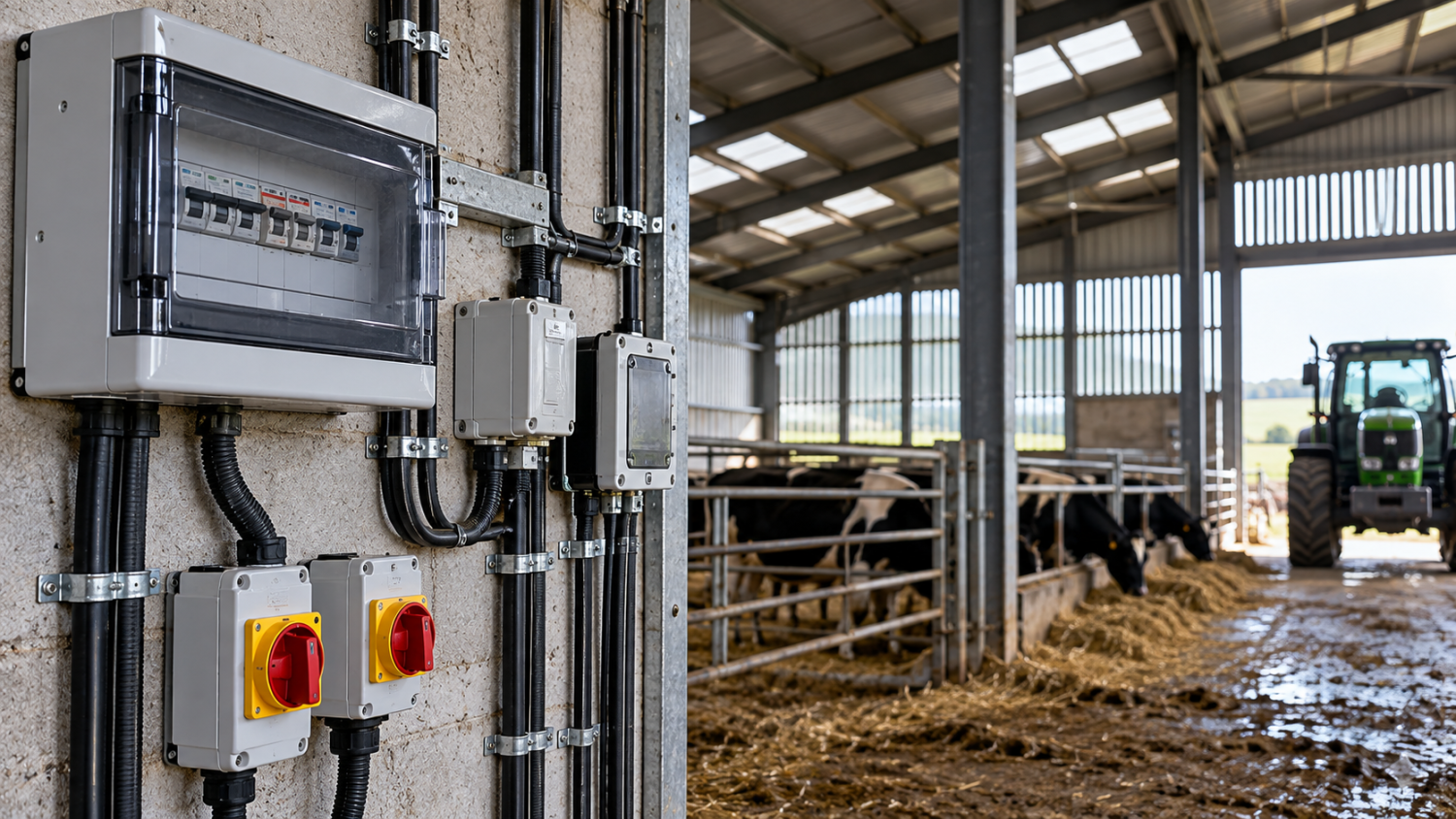
Farm electrics can trip for many reasons, including moisture getting into equipment, damaged cables, faulty machinery, deteriorated outdoor connections, rodents, overloaded circuits and faults in pumps, motors, refrigeration or other agricultural equipment.
Repeated tripping should not simply be treated as an inconvenience. An RCD, RCBO or circuit breaker is a protective device, and if it continues operating there may be an electrical fault that needs investigating.
For farms and rural businesses across Surrey, West Sussex, Kent and the wider South East, this guide explains:
- Why agricultural electrical systems can be particularly demanding
- What repeated RCD or RCBO tripping can mean
- How water and moisture affect farm electrics
- Why machinery and motors can cause faults
- How rodents can damage electrical cables
- Why outdoor electrical equipment needs particular attention
- How overloaded circuits can develop as farms expand
- Why intermittent faults can be difficult to find
- How an electrician investigates the problem
- How JPEC Electrical can help
Why are agricultural electrical systems particularly challenging?
Electrical installations on farms often operate in much harsher conditions than those in an ordinary home or office.
Depending on the site, electrical equipment may be exposed to moisture, dust, dirt, temperature changes, vibration, animals, machinery and outdoor conditions.
There can also be long cable runs between buildings and equipment spread across barns, workshops, stores, yards and external areas.
At the same time, farms can rely heavily on electricity for essential operations such as pumps, ventilation, refrigeration, lighting, feeding systems and machinery.
That combination makes good electrical design, protection and maintenance particularly important.
Why does my farm’s RCD keep tripping?
An RCD is designed to disconnect the electricity supply when it detects an imbalance that can indicate current leaking away from the intended electrical circuit.
If an RCD repeatedly trips, possible causes can include:
- water entering electrical equipment
- damaged cables
- faulty machinery
- deteriorated outdoor sockets or connections
- insulation faults
- multiple items of equipment contributing leakage current
- faults in underground or external supplies
The fact that an RCD can be reset does not prove the circuit is healthy.
If the same protective device repeatedly operates, the underlying cause should be identified.
What is the difference between an RCD, RCBO and circuit breaker?
These devices perform different protective functions.
A circuit breaker is primarily designed to protect a circuit against excessive current caused by overloads or faults.
An RCD monitors the balance of current flowing through the circuit and can disconnect the supply when leakage is detected.
An RCBO combines residual-current and overcurrent protection for an individual circuit.
Understanding which device has operated can provide useful information during fault finding, although it does not by itself identify the cause.
A qualified electrician can test the affected circuit rather than relying on guesswork.
Can rain cause farm electrics to trip?
Yes. Moisture is a common cause of electrical problems in outdoor and agricultural environments.
Rainwater can enter damaged or unsuitable:
- junction boxes
- outdoor sockets
- lighting fittings
- switchgear
- isolators
- cable connections
- equipment enclosures
A useful clue is when a circuit behaves normally during dry weather but begins tripping during or shortly after heavy rain.
However, that does not prove where the water is entering.
Electrical testing may be required to locate the affected part of the installation.
Can condensation cause electrical faults in agricultural buildings?
Potentially, yes.
Agricultural buildings can experience significant changes in temperature and humidity, particularly where buildings are naturally ventilated or where livestock, washing or agricultural processes produce additional moisture.
Condensation can affect unsuitable or deteriorated electrical equipment.
Equipment selection therefore needs to take account of the environment in which it will operate.
Simply using ordinary indoor electrical accessories throughout a harsh agricultural environment may not provide an appropriate long-term installation.
Can rodents damage farm wiring?
Yes. Rodent damage is a genuine concern on agricultural and rural sites.
Mice and rats can damage cable insulation, potentially exposing conductors or creating electrical faults.
The damage may occur in areas that are difficult to inspect visually, including roof spaces, stores, plant areas and behind equipment.
Signs of a problem may include unexplained tripping, damaged visible cables or faults that appear without any obvious change to the equipment being used.
Where rodent activity is known to be present, cable routes and protection should be considered as part of the electrical assessment.
Can farm machinery cause circuits to trip?
Yes. Motors and agricultural machinery can place significant demands on an electrical installation.
Depending on the site, this can include:
- pumps
- compressors
- conveyors
- ventilation fans
- grain-handling equipment
- refrigeration
- workshop machinery
- feeding systems
A fault within the equipment, its cable, isolator or control system can cause protective devices to operate.
Large motors can also have significant starting currents, which need to be considered when circuits and protective devices are designed.
Why does the breaker trip when a motor starts?
Electric motors can draw considerably more current while starting than they use once running normally.
The electrical circuit, protective device and starting arrangement need to be suitable for the particular motor and application.
If a motor that previously operated correctly suddenly begins causing trips, that can also indicate a developing problem rather than simply an undersized supply.
Possible issues include mechanical problems, motor faults, cable faults or changes elsewhere in the installation.
The correct response is to investigate the system rather than fitting a larger breaker without confirming that the circuit is suitable.
Can a bigger circuit breaker stop nuisance tripping?
Replacing a protective device with a higher-rated one simply to prevent tripping can be dangerous.
The protective device is selected in relation to the circuit design, cable capacity, load and fault protection requirements.
Increasing its rating without confirming that the wiring and installation can safely support it can remove important protection from the circuit.
If a breaker repeatedly trips, an electrician should establish why.
The solution may involve repairing a fault, changing the circuit design, providing a dedicated supply or addressing the equipment causing the problem.
Can farms outgrow their original electrical installation?
Yes. Agricultural businesses often develop gradually.
A barn may originally have been supplied for basic lighting and a few sockets before additional machinery, refrigeration, heating, ventilation or workshop equipment was added over many years.
The result can be an electrical installation carrying substantially more demand than was originally anticipated.
New equipment should therefore not automatically be connected to whichever circuit happens to be nearby.
JPEC Electrical can assess existing loads, distribution equipment and supply arrangements before additional agricultural equipment is installed.
Does three-phase equipment need special consideration?
Yes.
Many agricultural and industrial sites use three-phase electricity for larger motors, machinery and other higher-demand equipment.
The distribution of electrical loads across the phases, protective devices, cable sizing, isolation and characteristics of the equipment all need to be considered.
Problems can also occur if equipment develops a fault or there is an issue affecting one phase.
Three-phase electrical work should be assessed and carried out by appropriately competent electricians.
Can refrigeration faults cause electrical trips?
Yes.
Refrigeration and cold-storage equipment can be particularly important on agricultural sites because a power failure may threaten valuable stock or produce.
Compressors, fans, defrost equipment, controls and associated electrical components can all develop faults.
If refrigeration equipment repeatedly trips a circuit, restoring it over and over without establishing the cause risks further downtime.
Where loss of refrigeration has serious consequences, the electrical supply and contingency arrangements should form part of wider business planning.
What about water pumps and borehole equipment?
Pumps can be another important electrical load on rural and agricultural sites.
They may operate in or around wet environments and can be located some distance from the main electrical distribution equipment.
Faults can occur in the pump, motor, control equipment, cable or associated connections.
Because some components may be difficult to access, proper electrical testing is often needed to narrow down the source of the problem.
Any equipment associated with water and electricity should be approached cautiously when a fault is suspected.
Can damaged extension leads cause farm electrical problems?
Yes.
Extension leads and portable electrical equipment can experience hard use on farms and workshops.
Cables may be dragged across floors, driven over, exposed to moisture or damaged by machinery.
Long-term reliance on extension leads can also indicate that permanent socket provision no longer matches how the building is being used.
If equipment is regularly operated in the same location, a properly designed permanent electrical supply may provide a better solution than continually extending temporary cables across the site.
Why do outdoor sockets need to be suitable for the environment?
Outdoor electrical equipment needs to be selected and installed for the conditions it is likely to encounter.
That can include rain, dust, dirt, physical impact and temperature changes.
The IP rating of equipment indicates its level of protection against the ingress of solid objects and water under specified conditions.
However, an IP rating alone does not guarantee a good installation.
Cable entries, glands, mounting position, drainage, physical protection and how equipment is used can all affect long-term reliability.
Why does a fault sometimes disappear before the electrician arrives?
Intermittent electrical faults can be particularly frustrating.
Moisture may dry out, equipment may cool down or a machine may not be operating when the electrician visits.
This can make the fault appear to have disappeared.
Keeping a simple record can help.
Useful information includes what equipment was operating, which protective device tripped, the weather conditions and whether the problem occurred at a particular time or during a particular process.
This information can help an electrician narrow down the likely cause alongside electrical testing.
Should you keep resetting a tripping farm circuit?
No. Repeatedly resetting a protective device without understanding why it is operating is not a sensible long-term response.
If there is a genuine electrical fault, the protective device may be preventing a more dangerous situation.
If a circuit will not remain energised, equipment is damaged, there is a burning smell or there are signs of heat, water or exposed wiring, the affected equipment should not continue being used.
A qualified electrician should investigate the problem.
What should farm staff do if electrical equipment looks damaged?
Staff should not attempt to repair exposed or potentially live electrical equipment unless they are appropriately trained and authorised to do so.
Damaged equipment should be taken out of use where this can be done safely and reported to the person responsible for the site.
Particular warning signs include:
- burning smells
- scorch marks
- cracked enclosures
- exposed conductors
- damaged plugs or cables
- water inside electrical equipment
- unusual buzzing or crackling
Where there is immediate danger, the priority is keeping people and animals away from the affected area and obtaining competent assistance.
How does an electrician find an agricultural electrical fault?
Fault finding normally combines information about the problem with visual inspection and electrical testing.
Depending on the fault, an electrician may assess:
- distribution boards
- RCDs and RCBOs
- circuit breakers
- cables
- earthing and bonding
- insulation resistance
- equipment connections
- isolators
- outdoor supplies
- machinery circuits
The aim is to identify the affected circuit and then narrow down the actual cause rather than replacing components at random.
Is an EICR the same as electrical fault finding?
No.
An Electrical Installation Condition Report, or EICR, assesses the condition of the fixed electrical installation and records observations identified during the inspection and testing.
Targeted fault finding is focused on diagnosing a particular problem, such as a circuit that repeatedly trips.
Sometimes an EICR may reveal defects that require further investigation, but it should not be assumed that arranging a general condition report automatically diagnoses every intermittent machinery or equipment fault on a farm.
JPEC Electrical can advise which type of inspection or testing is appropriate for the problem.
Should agricultural electrics be inspected regularly?
Electrical installations should be maintained so that they remain safe for continued use.
Agricultural environments can place additional stress on electrical equipment because of moisture, dust, corrosion, animals and physical damage.
The appropriate inspection and maintenance programme depends on the installation and how it is used.
Businesses should also consider requirements under the Electricity at Work Regulations 1989, which place duties relating to electrical systems used at work.
A competent electrical contractor can advise on appropriate inspection and maintenance arrangements for the individual site.
Can preventative maintenance reduce electrical downtime?
It can help identify developing problems before they result in complete failure.
For a working farm, planned maintenance can be easier to manage than an unexpected electrical fault during a critical period.
This is particularly relevant for equipment such as ventilation, refrigeration, pumps, processing machinery and other systems where electrical failure could interrupt operations.
Maintenance cannot guarantee that equipment will never fail, but it can help identify damaged accessories, deteriorated equipment and other obvious concerns before they become more disruptive.
Should new farm machinery have its own electrical circuit?
Potentially. It depends on the equipment and the existing installation.
Higher-demand machinery may require a dedicated circuit designed around its electrical characteristics.
Before new equipment is connected, an electrician may need to consider:
- equipment power demand
- starting current
- existing circuit capacity
- cable size and route
- protective devices
- isolation
- earthing
- single-phase or three-phase requirements
Planning this before machinery arrives can reduce the risk of discovering that the existing supply is unsuitable on installation day.
Can JPEC Electrical work across a whole agricultural site?
Yes. JPEC Electrical provides electrical services for agricultural as well as commercial, industrial and domestic clients.
For a farm or rural business, that can include work across barns, workshops, stores, yards, offices and other buildings rather than treating each individual fault in isolation.
This can be particularly useful where an older agricultural site has been extended gradually and contains electrical equipment installed at different times.
The wider installation can be considered when planning repairs, additional circuits, new machinery or future upgrades.
JPEC Electrical can help
JPEC Electrical provides agricultural electrical fault finding, testing, installation and maintenance across Surrey, West Sussex, Kent and the wider South East.
If a farm circuit repeatedly trips, we can investigate the affected installation, identify the cause and explain the appropriate repair or upgrade rather than simply resetting the protective device.
We can also assess electrical supplies for new machinery, pumps, refrigeration, ventilation, workshops, barns and other agricultural equipment, including single-phase and three-phase installations.
For farms planning solar PV, battery storage, EV charging or wider energy upgrades, JPEC Electrical can also coordinate with JPEC Green Energy and the wider JPEC Group so the existing electrical infrastructure and future requirements are considered together.
To arrange agricultural electrical fault finding, inspection or installation work, contact JPEC Electrical.
This article provides general information and is not a substitute for an electrical inspection or site-specific design. Electrical faults can present serious risks. Do not remove covers, touch exposed conductors or attempt repairs to live electrical equipment. Recommendations should be confirmed by an appropriately competent electrician following inspection and testing of the individual installation.