Your home’s electrical supply may be perfectly adequate for everything you use today but that does not automatically mean it has unlimited capacity for new electrical equipment.
EV chargers, heat pumps, electric showers, induction hobs, electric heating, air conditioning and other high-demand equipment can significantly change how much electricity a property may require. Before substantial new electrical loads are added, an electrician should consider the existing supply, consumer unit, circuits and expected maximum demand.
For homeowners in Horley, Reigate, Redhill, Crawley, Surrey and West Sussex, this guide explains:
- What electrical supply capacity means
- What your main fuse does
- Why adding up every appliance is not the right calculation
- What maximum demand and diversity mean
- How EV chargers affect electrical demand
- How heat pumps affect the calculation
- What happens when several high-power appliances are installed
- How load management can help
- When the DNO may need to be involved
- When three-phase electricity might be considered
What does electrical supply capacity actually mean?
Your property is connected to the local electricity distribution network through an incoming electrical supply.
That supply has a finite capacity. The electrical installation inside your property also contains cables, protective devices, a consumer unit and other equipment that must be suitable for the electricity being used.
For many years, a typical home may have had relatively predictable electrical requirements from lighting, sockets, cooking appliances and household equipment.
Homes are now increasingly adding larger electrical loads, making supply capacity an important consideration during electrical upgrades.
What is the main fuse in my house?
The main fuse, often referred to as the service or cut-out fuse, is associated with the incoming electricity supply to the property.
Its rating forms part of understanding the capacity available to the installation.
Depending on the property and electricity network arrangement, domestic supplies may have different fuse ratings.
You should not remove, open or interfere with the electricity network operator’s cut-out equipment yourself.
If the rating or condition of the incoming supply needs to be confirmed, your electrician and Distribution Network Operator can establish the appropriate information.
Does a bigger consumer unit mean I have more electricity available?
No.
A consumer unit distributes electricity around the property and contains protective devices for the individual circuits.
Installing a larger or newer consumer unit does not automatically increase the capacity of the electricity supply coming into the building.
The incoming supply, service equipment, meter tails, consumer unit and electrical circuits all need to be considered as parts of the complete installation.
This is why simply looking at the number of spare spaces in a consumer unit does not tell you whether another high-demand appliance can be added.
What is maximum demand?
Maximum demand is an assessment of the greatest electrical demand that the installation is expected to place on its supply.
This matters because a house could contain a large number of electrical appliances without every one of them operating at maximum power simultaneously.
An electrician therefore does not simply add together every watt printed on every appliance in the house.
The expected use of the installation needs to be considered using appropriate electrical-design principles.
As more long-duration electrical loads are introduced into homes, maximum-demand assessment becomes increasingly important.
What does diversity mean in an electrical installation?
Diversity recognises that not every electrical load in a property will necessarily operate at its maximum demand at exactly the same time.
For example, every socket in the house will not normally be supplying its maximum possible load simultaneously.
However, diversity should not simply be used as an excuse to ignore significant new electrical loads.
An EV charger could operate for several hours. A heat pump may also operate for long periods during cold weather. Electric heating, hot-water equipment and other loads may be running at the same time.
The electrician needs to assess a realistic combination of loads rather than making an optimistic assumption that they will never coincide.
Why are modern homes using more electricity?
Electrification is changing the type of equipment installed in UK homes.
A property may now contain:
- an EV charger
- an air source heat pump
- an induction hob
- an electric shower
- electric underfloor heating
- air conditioning
- an immersion heater
- solar PV and battery equipment
- electric garden or workshop equipment
- multiple home-office setups
Not all of these technologies create the same type of electrical demand, but together they can make electrical design more important than it was when the property was originally wired.
How much difference does an EV charger make?
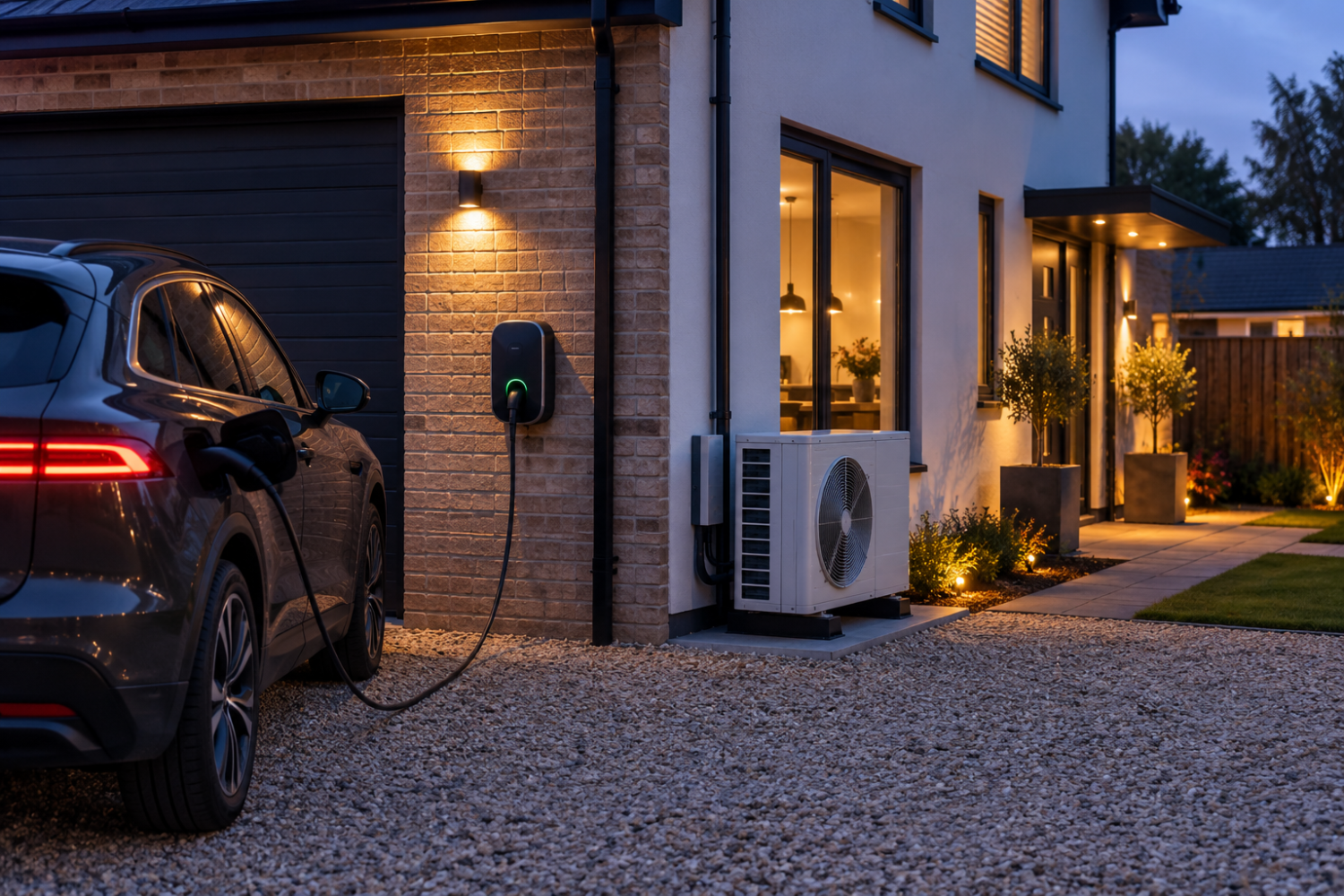
A typical single-phase home EV charger can represent a substantial additional electrical load and may operate continuously for several hours while the vehicle charges.
This makes EV charging different from many household appliances that only operate at high power for short periods.
Before installing a charger, the installer needs to assess the adequacy of the electrical supply and the existing installation.
Depending on the charger and property, load-management technology may also be used to control the amount of electricity available to the charger when the rest of the home’s demand increases.
JPEC Electrical can assess EV charging as part of the property’s wider electrical requirements rather than treating the charger as an isolated appliance.
How does a heat pump affect electrical demand?
An air source heat pump uses electricity to move heat into the property rather than creating all of its heat directly from electrical resistance.
Its electrical input is therefore different from its headline heating output.
However, it still represents a significant electrical load that needs to be considered during system design.
Some systems may also contain immersion heaters or supplementary electrical heating that needs to be accounted for.
This is particularly important when considering a worst-case winter situation where the heat pump, hot-water equipment and other household loads may all be operating.
What if I have an EV charger and a heat pump?
Having both does not automatically mean your electrical supply needs upgrading.
It does mean the combined electrical demand needs to be properly assessed.
The electrician should consider the existing installation alongside the proposed equipment and how it is expected to operate.
In some properties the existing supply may be suitable.
Others may benefit from load-management arrangements or changes to the installation. In some circumstances, work involving the incoming electricity supply may need to be discussed with the DNO.
The correct answer depends on the individual property rather than a blanket rule.
What about an electric shower?
Electric showers can be particularly high-demand appliances because they heat cold water almost instantly.
However, they are normally used for relatively short periods compared with equipment such as an EV charger or heat pump.
The shower still needs an appropriately designed dedicated circuit, and its demand needs to be considered as part of the wider installation.
If you are adding a powerful electric shower to a property that already has several substantial electrical loads, the overall supply should be considered rather than assessing each installation independently.
Does an induction hob use a lot of electricity?
Induction hobs can have a high connected electrical load, although actual demand depends on how the appliance is being used and its design.
Modern cooking appliances may incorporate power-management functions, but the manufacturer’s electrical requirements still need to be followed.
An electrician should design the circuit appropriately and consider the cooking equipment as part of the property’s overall electrical demand.
This becomes particularly relevant during kitchen renovations where several new electrical appliances are being introduced at the same time.
What happens if my electrical supply is not big enough?
If an assessment shows that the proposed electrical demand cannot appropriately be accommodated by the existing arrangement, that does not necessarily mean the project has to stop.
Possible solutions depend on the cause and could involve:
- load-management equipment
- alterations to the electrical installation
- changes to how particular equipment is controlled
- upgrading relevant electrical equipment
- liaising with the DNO about the incoming supply
- considering a different supply arrangement for larger projects
The solution should be engineered around the property rather than simply increasing protective-device ratings.
What is electrical load management?
Load management allows certain electrical equipment to respond to the total demand being placed on the property.
An EV charger is a common example.
A suitable system may monitor the electricity being used by the property and automatically reduce the charger’s output if household demand becomes high.
When other loads reduce, more capacity can become available for vehicle charging again.
This can help manage the available electrical capacity without requiring the homeowner to manually switch appliances on and off.
Whether load management is appropriate depends on the equipment, electrical installation and intended use.
Can battery storage help manage electrical demand?
Battery systems can affect how electricity flows through a property, but they should not simply be assumed to solve a supply-capacity problem.
A battery may be able to discharge when household demand is high, depending on the system design and control strategy.
However, the battery also needs to charge at other times and its inverter has defined power limits.
Solar PV, battery storage, EV charging and heat pumps increasingly interact within the same home energy system.
Where several technologies are being installed, coordinated electrical and energy design can be much more useful than treating each system separately.
Who is the DNO?
DNO stands for Distribution Network Operator.
The DNO operates the local electricity distribution network that supplies your property.
It is different from the company that sends you your electricity bill.
Depending on the work being proposed, the DNO may need to be notified or an application may need to be made.
The DNO can also be involved where changes are required to network-owned equipment or the incoming supply.
Your electrical or low-carbon technology installer can identify when DNO involvement is required.
Can my electrician just replace the main fuse?
No. The service cut-out and main fuse associated with the distribution network should not simply be altered by a domestic electrician or homeowner.
Network-owned equipment is controlled by the relevant DNO and authorised organisations.
If an increased supply capacity is required, the existing service needs to be assessed and the appropriate process followed.
There may be more involved than changing a fuse. The suitability of the service cable, cut-out and other network equipment may also need to be considered.
JPEC can identify supply issues during the project and coordinate the appropriate next steps where required.
Do I need a three-phase electricity supply?
Most ordinary UK homes have historically used a single-phase electricity supply.
Three-phase supplies are common in commercial, industrial and agricultural properties and may also be found or considered in larger residential properties with substantial electrical requirements.
Adding an EV charger or heat pump does not automatically mean you need three-phase electricity.
The first step should be assessing the existing supply, expected demand and available load-management options.
Where a property has unusually high demand, multiple EV chargers or substantial electrical equipment, the designer and DNO can consider whether a different supply arrangement is appropriate.
How can I find out what electrical supply I have?
Some information may be visible around the meter position and service equipment, but homeowners should not remove covers, seals or attempt to inspect the main fuse internally.
An electrician can inspect the accessible installation and identify the information required for the project.
Where the incoming fuse rating or network capacity cannot be reliably established, confirmation can be obtained through the appropriate electricity network operator.
For larger upgrades, it is better to establish this early rather than discover a supply limitation after new equipment has already been purchased.
Should I have my supply checked before renovating?
If a renovation will significantly increase electrical demand, yes, considering the supply early can prevent problems later.
This is particularly useful if the project includes several of the following:
- an EV charger
- a heat pump
- an electric shower
- an induction hob
- electric underfloor heating
- air conditioning
- a garden room
- workshop equipment
- solar PV
- battery storage
The electrical design can then take account of the finished property rather than adding each new load separately as the project progresses.
Can my electricity use be monitored before deciding?
In some situations, monitoring actual electrical demand can provide useful information about how a property or larger site is using electricity.
This can be particularly valuable where existing demand is uncertain or where several substantial new loads are being considered.
Rather than relying only on annual electricity consumption, monitoring can show when demand peaks and how it changes throughout the day.
For more complex domestic, commercial or agricultural projects, JPEC Electrical can consider appropriate monitoring and assessment as part of planning future electrical requirements.
Why is it worth planning future electrical demand now?
A homeowner may not be installing every electrical technology at once.
You might install a heat pump today and consider an EV next year. A future extension could add electric cooking, air conditioning or additional heating.
During a rewire or major consumer-unit project, discussing those future plans allows the electrician to consider them during the design.
That could mean thinking about circuit capacity, consumer-unit space, cable routes and the wider electrical supply before the property is decorated.
Planning does not mean unnecessarily oversizing the installation. It means avoiding preventable problems later.
JPEC Electrical can help
JPEC Electrical provides electrical design, installation, inspection, testing and monitoring for homeowners, landlords and businesses across Horley, Reigate, Redhill, Crawley, Surrey, West Sussex and the wider South East.
If you are adding an EV charger, heat pump, electric shower, induction hob, electric heating or several new electrical systems, we can assess the existing installation and consider how the additional loads will interact.
As part of JPEC Group, our electrical team can also work alongside JPEC Green Energy where projects involve solar PV, battery storage, heat pumps and EV charging. This allows the electrical supply and the energy technologies to be considered together.
Where supply-network involvement is required, we can explain the process and the information needed for the project.
JPEC Electrical is NICEIC registered and has provided electrical services across domestic, commercial, industrial and agricultural properties since 2003.
To discuss your property’s electrical capacity or an upcoming electrical upgrade, contact JPEC Electrical.
This article provides general electrical information and is not a calculation of the available capacity at a specific property. Electrical maximum demand, supply adequacy and circuit requirements should be assessed by appropriately competent professionals using the details of the actual installation and proposed equipment.