
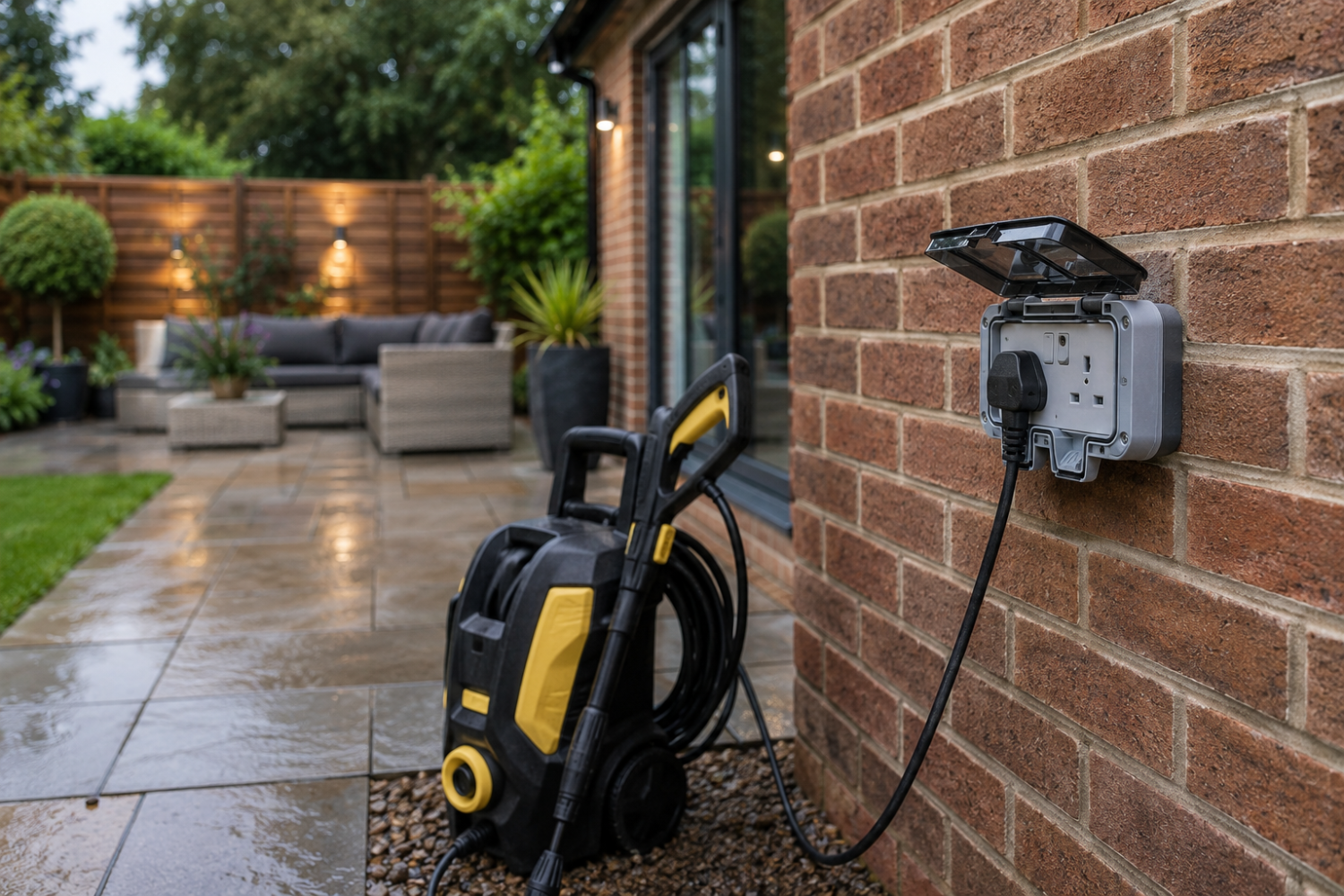
A properly installed outdoor socket can be a useful addition to a UK home, particularly if you regularly use garden equipment, pressure washers, outdoor lighting or other electrical equipment outside. However, an outdoor socket needs to be suitable for external conditions, correctly supplied, appropriately protected and positioned where it can be used safely.
If you are considering an outside socket at your home in Horley, Reigate, Redhill, Crawley, Surrey or West Sussex, this guide explains:
- When an outdoor socket is useful
- Why an indoor socket should not simply be extended outside
- What weather protection an outdoor socket needs
- Why RCD protection matters
- Where an outdoor socket should be positioned
- Whether cables can run outside
- What to consider for garden equipment
- What changes if you want to power a hot tub or other large load
- Whether you can add more than one outdoor socket
- What an electrician checks before installation
Is an outdoor socket worth having?
If you regularly need electricity in your garden, a permanent outdoor socket can be considerably more practical than repeatedly running extension leads through doors or windows.
Common uses include lawnmowers, pressure washers, garden tools, occasional outdoor appliances and some types of garden lighting.
It can also make future garden projects easier because there is already an appropriately designed external power point available.
Whether you actually need one depends on how you use your garden. The important point is that if permanent outdoor power would be useful, it should be designed for that environment rather than improvised using indoor equipment.
Why can’t I just run an extension lead from inside?
An extension lead can be suitable for temporary use when the lead and connected equipment are appropriate for the conditions, but it is not a replacement for a properly installed permanent outdoor supply.
Running cables through windows, doors and across paths can expose them to physical damage. Equipment intended only for indoor use may also be unsuitable for moisture and changing weather conditions.
There is also a risk of overloading extension leads when several items are connected.
If you find yourself running an extension lead into the garden every weekend, installing a permanent external socket may provide a more practical solution.
Are outdoor sockets waterproof?
Outdoor electrical equipment is designed to provide a defined level of protection against environmental conditions, but describing every external socket as simply “waterproof” can be misleading.
Electrical enclosures use an IP rating, which stands for ingress protection. This indicates the level of protection provided against things such as solid objects and water.
The appropriate equipment should be selected for the location and expected exposure.
A socket beneath a substantial covered area may experience different conditions from one installed on an exposed garden wall in West Sussex.
The enclosure also needs to remain correctly closed and maintained for its intended protection to be effective.
Does an outdoor socket need RCD protection?
Appropriate RCD protection is particularly important for outdoor electrical use.
An RCD, or residual current device, is designed to disconnect the electricity supply rapidly when certain types of electrical fault occur.
Modern electrical installations use RCD protection as one element of protection against electric shock.
Electrical Safety First recommends using an RCD when using electrical equipment outdoors.
However, RCD protection is not a substitute for correct wiring, suitable outdoor equipment, earthing and proper circuit protection. These measures form part of the complete electrical design.
Where should an outdoor socket be installed?
The best position depends on what you want to use it for and the layout of the property.
It should be accessible without being unnecessarily exposed to damage or positioned where leads immediately create a trip hazard.
For example, placing a socket on the rear wall of a house in Horley may work well for general garden equipment. A larger property in Reigate might benefit from power being available in a different part of the garden.
The electrician also needs to consider how the cable reaches the socket and what electrical supply is available at the proposed position.
Can an electrical cable be run outside the house?
Yes, provided the wiring system is suitable for the location and installed correctly.
External cables can be exposed to sunlight, rain, temperature changes and physical damage, so the electrician needs to choose an appropriate cable and installation method.
Some installations may allow a discreet cable route directly through the wall from the internal electrical installation. Others may require a longer external route.
Where possible, good planning can help keep the finished installation neat rather than covering the outside of the property with unnecessary visible cabling or trunking.
Can I use an outdoor socket for a lawnmower or pressure washer?
Outdoor sockets are commonly used for portable garden equipment, provided the socket, circuit and equipment are suitable.
Always inspect portable electrical equipment and its cable before use.
Do not use equipment with damaged plugs, split cables or exposed conductors.
When using a lawnmower or other cutting equipment, keep the electrical cable clear of the working area.
Water and electricity also require particular care. A pressure washer may be designed for outdoor use, but its electrical connections still need to be protected and used according to the manufacturer’s instructions.
Can I plug a hot tub into an outdoor socket?
Do not assume that an existing general-purpose outdoor socket is automatically suitable for every hot tub.
The electrical requirements depend on the particular hot tub, its power demand, manufacturer’s instructions and installation arrangement.
Larger hot tubs and spas can require a dedicated electrical supply and additional design considerations because electrical equipment is being used in close proximity to water.
If you are buying a hot tub, give the electrician the exact manufacturer’s electrical specification before installation.
This allows the supply requirements to be assessed properly rather than discovering after delivery that the existing garden electrics are unsuitable.
What about outdoor heaters and high-powered equipment?
The same principle applies to other equipment with a significant electrical demand.
An outdoor socket should not be treated as an unlimited source of power simply because an appliance has a plug that fits it.
Patio heaters, pumps and other larger electrical loads may need to be considered individually.
If you plan to use several items simultaneously, tell the electrician when the outdoor supply is being designed.
This helps ensure the circuit is appropriate for its intended use rather than being designed around one small appliance and later expected to supply considerably more.
Can I have several sockets around the garden?
Potentially, yes.
If you have a larger garden, workshop area, patio or several locations where power would be useful, an electrician can assess the most appropriate way of distributing the supply.
However, adding sockets in several places means the cable routes, electrical demand, protection and environmental conditions need to be considered as a complete installation.
It is usually better to explain your full plans at the beginning rather than installing one socket and repeatedly extending the system as new ideas arise.
Can an outdoor socket be used for garden lighting?
Some plug-in outdoor lighting systems are designed to be supplied from an appropriate socket, while permanent garden lighting may be installed as part of a fixed electrical installation.
The right approach depends on the type of lighting and how you want it controlled.
A permanent installation can incorporate features such as switching, timers or suitable automatic controls where required.
For landscaped gardens, planning the electrical work before paving, planting and other finishes are completed can make cable routing considerably easier.
It can also help avoid disturbing finished landscaping later.
What if water gets inside an outdoor socket?
If an external electrical accessory appears damaged or has water inside it, do not continue using it simply because it still works.
Outdoor enclosures can deteriorate, become damaged or fail to seal correctly over time.
Cracked covers, broken hinges, damaged seals or loose fittings can affect the protection the enclosure provides.
Arrange for damaged outdoor electrical equipment to be inspected and replaced where necessary.
Do not dismantle a wet electrical accessory yourself to investigate inside it.
Does an outdoor socket need maintenance?
It is sensible to keep an eye on the condition of outdoor electrical equipment.
Look for obvious signs of deterioration such as:
- cracked or broken covers
- damaged seals
- loose enclosures
- discolouration or overheating
- damaged cables
- water or condensation where it should not be
If something does not look right, stop using the affected equipment and have it checked.
External electrical accessories experience harsher conditions than most equipment installed inside a property, so physical condition matters.
Does installing an outdoor socket come under Part P?
Part P of the Building Regulations applies to relevant electrical installation work associated with dwellings in England, including electrical installations in gardens and on land associated with the dwelling.
However, not every addition of an outdoor socket automatically requires Building Control notification.
If the work involves installing a new circuit, that is notifiable work under Part P. Certain alterations to an existing circuit can be non-notifiable while still needing to comply with the applicable electrical safety requirements.
A registered electrical contractor can establish what applies to the proposed installation and complete the appropriate compliance process where required.
What should an electrician check before installing one?
The electrician needs to consider more than the position of the socket.
Depending on the installation, checks may include:
- the existing electrical circuit
- consumer unit and protective devices
- RCD protection
- earthing arrangements
- expected electrical load
- cable type and route
- environmental exposure
- the condition of the existing installation
- what equipment you intend to use
If a new circuit is required, the electrician can then design it around the intended use rather than simply selecting a cable based on the distance to the garden.
What certification should I receive?
The appropriate electrical documentation depends on the work completed.
A new circuit would normally require an Electrical Installation Certificate following appropriate inspection and testing.
Certain additions or alterations to an existing circuit may instead require a Minor Electrical Installation Works Certificate where appropriate.
If the work is notifiable under Part P, the relevant Building Regulations compliance process should also be completed.
Keep the documentation with your property records.
JPEC Electrical can help
JPEC Electrical can design and install outdoor electrical supplies for homes, landlords and businesses across Horley, Reigate, Redhill, Crawley, Surrey and West Sussex.
Whether you need a single outdoor socket or are planning a wider garden electrical installation, our electricians can assess the existing installation, intended electrical loads, cable routes and required protection before recommending an appropriate solution.
JPEC Electrical can install, inspect, test and commission the electrical work and provide the appropriate certification on completion.
If the project forms part of a larger garden room, renovation, lighting or landscaping project, the wider JPEC Group can also help coordinate associated works where appropriate.
To arrange an electrical assessment and quotation, contact JPEC Electrical.
This article provides general information and is not personal electrical or Building Regulations advice. Outdoor electrical requirements depend on the existing installation, equipment, environment and intended use. Recommendations should be confirmed through an appropriate electrical assessment and design by a suitably competent electrician.