Most UK homes can have an induction hob installed, but you should not assume that a new induction hob can simply be connected to the wiring used by your existing cooker. The electrician needs to check the hob’s electrical rating, the existing cooker circuit, cable size, protective device, consumer unit, electrical supply and the manufacturer’s installation requirements.
This is particularly worth checking before ordering a high-powered hob or starting a kitchen renovation. For homeowners in Horley, Reigate, Redhill, Crawley, Surrey and West Sussex, this guide explains:
- How much electricity an induction hob can require
- Whether you need a dedicated circuit
- Whether your existing cooker cable can be reused
- Why the hob’s maximum rating matters
- Whether your consumer unit needs upgrading
- What happens if you also have an electric oven
- How other large electrical loads affect the design
- Whether an induction hob can be power-limited
- When the electrical work should happen during a kitchen renovation
- What testing and certification you should receive
Can any house have an induction hob?
In many cases, yes, but the existing electrical installation needs to be suitable for the particular hob you want to install.
Induction hobs vary considerably in their electrical requirements. A compact model designed for a smaller kitchen may have very different requirements from a large multi-zone induction hob.
This means an electrician should work from the manufacturer’s electrical information for the actual appliance rather than assuming all induction hobs are the same.
If you are replacing a gas hob with induction, this is particularly important because there may not currently be a suitable electrical circuit at the hob position.
Why can an induction hob need so much electricity?
An induction hob uses electricity to create a magnetic field that heats suitable cookware directly.
With several cooking zones operating simultaneously, the potential electrical demand can be significant.
The manufacturer’s stated connected load is therefore an important part of the electrical design.
You may see this expressed in kilowatts, abbreviated to kW. A kilowatt is simply a measure of power.
The electrician uses the appliance information alongside the characteristics of the circuit and installation to determine how the hob should be supplied.
Does an induction hob need its own circuit?
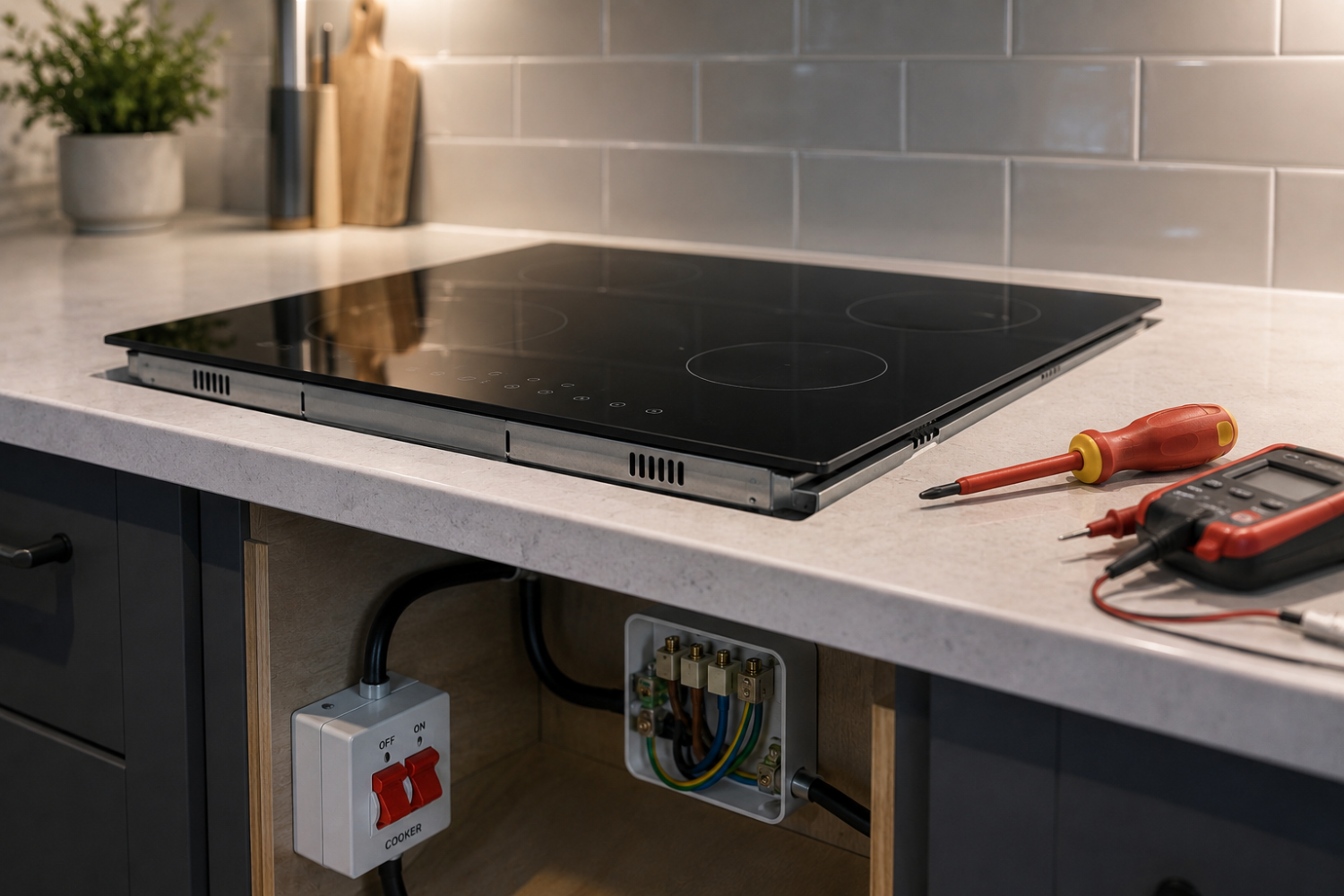
Many induction-hob installations use a dedicated cooker circuit, but the correct arrangement depends on the appliance and electrical design.
A dedicated circuit runs from the consumer unit to the cooking equipment rather than simply plugging the hob into a general socket circuit.
Higher-powered fixed cooking appliances need appropriate cables, protective devices, connections and isolation arrangements.
The electrician will also consider whether an oven shares the cooking-appliance circuit or is supplied separately.
There is no sensible one-size-fits-all answer without knowing which appliances are being installed.
Can I use the cable from my old electric hob or cooker?
Possibly, but it needs to be checked first.
An existing cooker circuit may be suitable for the new appliance, particularly where the previous kitchen already had electrically powered cooking equipment.
However, the electrician needs to establish what cable has actually been installed, how it is routed, what protective device supplies it and what electrical load it was designed to serve.
The fact that a cable physically reaches the new hob does not prove that it is suitable.
If the new equipment places different demands on the circuit, alterations or a new circuit may be required.
What if I am changing from gas to induction?
This is where early electrical planning becomes particularly useful.
A gas hob may only require a small electrical supply for ignition, controls or other functions. That does not mean the same supply can power an induction hob.
If there is no suitable cooker circuit already available, an electrician may need to install a new circuit from the consumer unit to the kitchen.
The amount of disruption depends heavily on the property and available cable route.
In a kitchen that is already being stripped out, routing a new cable can be considerably easier than doing it after new cabinets, worktops and decoration have been completed.
Will I need a bigger electrical supply?
Not necessarily.
Installing an induction hob does not automatically mean the incoming electricity supply to your home needs upgrading.
An electrician should consider the expected demand of the property as a whole rather than simply adding together the maximum rating of every electrical appliance.
The assessment becomes increasingly important where a property also has equipment such as:
- an EV charger
- an electric shower
- electric heating
- air conditioning
- a heat pump
- battery storage
- other high-powered cooking equipment
A modern home can contain several significant electrical loads, so they should be considered as part of one overall installation rather than independently.
Does my consumer unit need upgrading?
Not automatically.
The electrician needs to assess whether the existing consumer unit is suitable for the proposed work.
Relevant considerations can include the condition of the equipment, available capacity, existing protective devices and whether there is suitable provision for the new or altered circuit.
An older consumer unit should not be condemned purely because you want an induction hob.
Equally, adding a substantial new electrical load without assessing an unsuitable existing installation would not be good electrical design.
The recommendation should follow inspection and testing.
Can an induction hob and electric oven use the same circuit?
They sometimes can, but it depends on the design and the appliances involved.
The electrician needs the electrical ratings and manufacturer’s instructions for both the hob and oven.
Some kitchens have a cooking-appliance circuit serving more than one item. Other installations use separate circuits.
This is why buying the appliances first and assuming they will connect to whatever wiring is already behind the kitchen units can cause problems.
If you are having a new kitchen designed in Crawley or Reigate, giving the electrician the appliance specifications early allows the electrical installation to be designed properly before the kitchen is fitted.
What is diversity in a cooker circuit?
Diversity is an electrical-design principle that recognises that electrical equipment does not necessarily operate at its maximum possible demand continuously and simultaneously.
Cooking appliances are a good example because heating elements and cooking zones cycle as temperatures are controlled.
An electrician can take the applicable design principles into account when assessing a cooking-appliance circuit.
However, diversity should not be treated as a DIY formula for deciding whether an existing cable is suitable.
The complete circuit still needs to satisfy the relevant requirements for cable capacity, protective devices, voltage drop, fault protection and the manufacturer’s instructions.
Can an induction hob be limited to use less power?
Some induction hobs include a configurable power-management function that allows the maximum electrical demand to be limited.
Whether this is available depends entirely on the particular manufacturer and model.
Where supported, it can sometimes provide additional design options for properties where electrical capacity is constrained.
There is a trade-off, however. Limiting the maximum available power can affect how much power the hob can distribute between cooking zones when several are being used at once.
This should therefore be discussed before installation rather than simply changing settings without understanding the effect.
What if I also have an EV charger or heat pump?
Having other large electrical loads does not automatically prevent you from installing an induction hob.
It does mean the overall electrical demand deserves proper consideration.
For example, a home in Horley might contain an induction hob, electric oven, EV charger, heat pump and battery system. Each system may be perfectly suitable individually, but the electrical installation still needs to be designed around how the property operates as a whole.
Depending on the equipment, technologies such as load management may also be relevant.
A joined-up electrical design is particularly valuable as UK homes become increasingly electrified.
Should I call an electrician before buying the hob?
If you are unsure about the existing circuit, yes.
This is especially worthwhile if:
- you are changing from gas to induction
- you want a particularly large induction hob
- the property has an older consumer unit
- you do not know what size cooker circuit is installed
- the kitchen is being completely renovated
- you are installing a new oven at the same time
- your home already has several large electrical loads
Checking first can prevent you from purchasing an appliance and only discovering during installation that additional electrical work is required.
When should the electrical work happen during a kitchen renovation?
Electrical planning should happen early.
Ideally, the electrician should know the kitchen layout and appliance specifications before the first-fix electrical work is completed.
First fix is the stage where cables and other concealed electrical infrastructure are installed before walls and finishes are completed.
The electrician can then position supplies for the hob, oven, extractor, dishwasher, fridge, sockets and lighting around the final kitchen design.
This can help avoid visible cables, unnecessary surface trunking and alterations to newly fitted cabinets or worktops.
For a larger renovation, JPEC Group can also coordinate electrical work with associated building services where appropriate.
Does installing an induction hob come under Part P?
Part P of the Building Regulations covers electrical safety in dwellings in England.
Not every appliance connection automatically requires Building Control notification.
However, installing a new electrical circuit is notifiable work under Part P. Therefore, if the induction-hob installation requires a new circuit, the appropriate notification process needs to be followed.
Other alterations may be non-notifiable while still needing to comply with the applicable electrical safety requirements.
A suitably registered electrical contractor can explain which requirements apply to the work being completed.
What electrical standard applies?
Electrical installation work should be designed, installed, inspected and tested in accordance with the applicable requirements of BS 7671, commonly known as the IET Wiring Regulations.
As of September 2026, BS 7671:2018+A4:2026 has been published, with the previous Amendment 3:2024 edition remaining within its formal transition period until 15 October 2026.
The electrician should also follow the appliance manufacturer’s installation instructions.
BS 7671 is a technical standard rather than itself being an Act of Parliament. Building Regulations, including Part P in England, impose separate legal requirements.
What certification should I receive?
The electrical documentation depends on what work is carried out.
If a new circuit is installed for the induction hob, an Electrical Installation Certificate would normally be provided following appropriate inspection and testing.
Where the work is notifiable under Part P, the applicable Building Regulations compliance process should also be completed.
Alterations to an existing circuit may require different electrical certification depending on the scope of the work.
Keep the documentation with your property records for future inspections, renovations and property sales.
JPEC Electrical can help
If you are considering an induction hob, JPEC Electrical can assess the existing electrical installation before the appliance is installed.
We work with homeowners, landlords, developers and businesses across Horley, Reigate, Redhill, Crawley, Surrey and West Sussex.
Our electricians can check the existing cooker circuit, consumer unit, electrical capacity and proposed appliance specifications before explaining whether the existing installation can be used or whether alterations are required.
Where a new or upgraded circuit is needed, JPEC Electrical can design and install the electrical supply, complete the appropriate inspection and testing and provide the relevant certification.
If the induction hob forms part of a larger kitchen renovation, the wider JPEC Group can also help coordinate electrical and associated building work where appropriate.
To arrange an electrical assessment or quotation, contact JPEC Electrical.
This article provides general information and is not personal electrical advice. The electrical requirements for an induction hob depend on the appliance, existing wiring, circuit design, consumer unit and wider electrical installation. Recommendations should be confirmed through an appropriate electrical assessment and design by a suitably competent electrician.