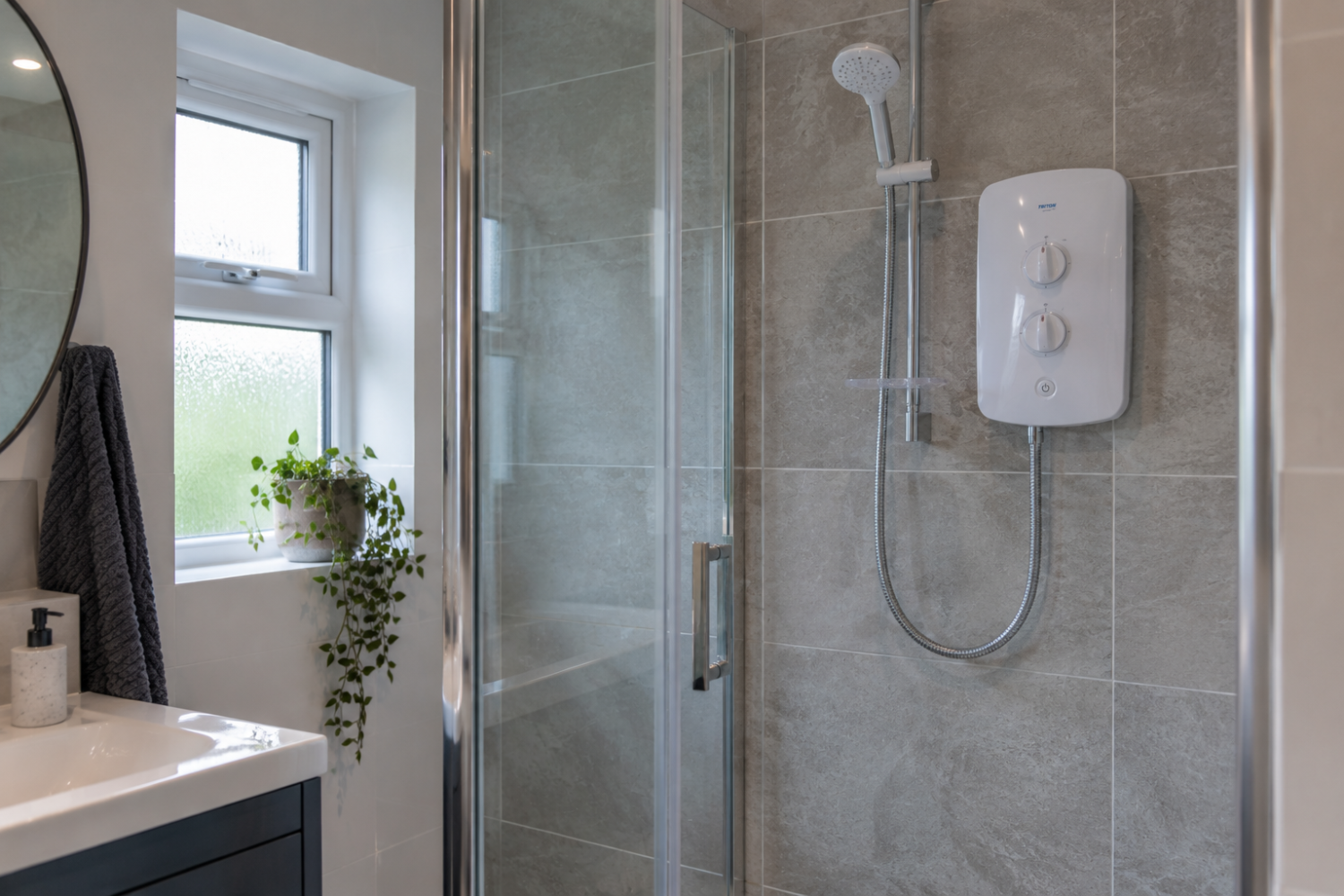
You may be able to install a more powerful electric shower, but you cannot assume that the existing shower cable, circuit breaker and electrical supply are suitable simply because an electric shower is already fitted.
Increasing from an older or lower-powered shower to a higher-kilowatt model can significantly increase the electrical demand on the circuit. Before a replacement is selected, an electrician should assess the existing circuit, cable, protective device, RCD protection, consumer unit and incoming electrical supply.
For homeowners and landlords in Horley, Reigate, Redhill, Crawley, Surrey and West Sussex, this guide explains:
- Why electric showers use so much electricity
- Whether you can replace an electric shower with a more powerful model
- Why the existing cable size matters
- Why the circuit breaker cannot simply be made larger
- Why electric showers normally need a dedicated circuit
- What an electrician checks at the consumer unit
- How RCD protection applies
- Whether your incoming electrical supply has enough capacity
- Why cable routes affect electrical design
- When a new shower circuit may be required
Why do electric showers need so much electrical power?
An electric shower heats cold mains water as you use it rather than relying on hot water stored elsewhere in the property.
Producing that heat almost instantly requires a substantial amount of electrical power.
Electric showers are therefore among the higher-demand electrical appliances commonly found in UK homes.
The higher the shower’s rated power in kilowatts, the greater the electrical current it can require when operating.
This is why changing the shower is not always as straightforward as removing the old unit and fitting a more powerful replacement in the same position.
Can I replace my existing electric shower with a more powerful one?
Possibly, but the existing electrical circuit needs to be assessed first.
For example, a homeowner may want to replace an older lower-powered shower with a higher-output model in the hope of improving shower performance.
The new unit could place greater demand on the electrical circuit than the original shower.
An electrician therefore needs to establish whether the existing installation was designed to safely supply that increased load.
If it was not, alterations or a completely new circuit may be necessary before the higher-powered shower can be installed.
Does an electric shower need its own circuit?
Electric showers are normally supplied by a dedicated circuit from the consumer unit.
This means the circuit is designed specifically to supply the shower rather than sharing its capacity with general sockets or other household appliances.
The circuit needs to be correctly designed around the electrical demand of the shower and the installation conditions.
Electrical Safety First advises that an electric shower should be supplied on its own circuit.
That dedicated circuit is an important part of safely supplying such a high-demand appliance.
Why does the shower cable size matter?
Electrical cables have limits on how much current they can safely carry under particular installation conditions.
The correct cable cannot be selected purely from the shower’s headline power rating.
An electrician also needs to consider factors such as:
- the shower’s electrical load
- the length of the cable run
- how the cable has been installed
- whether it passes through thermal insulation
- ambient conditions
- whether cables are grouped together
- the protective device
- voltage drop
- the requirements of the shower manufacturer
This is one reason why copying the cable used in another property is not an appropriate way to design a shower circuit.
Can I tell the cable size by looking at it?
Not reliably enough to design an electrical circuit.
Part of the cable may be visible near the shower, isolation switch or consumer unit, but the electrician also needs to understand its route and installation conditions.
A cable that disappears into a wall could pass through a loft, insulation, floor voids or other areas that affect its current-carrying capacity.
Previous alterations can make matters more complicated.
For this reason, the existing installation should be properly assessed rather than assuming the circuit is suitable because the old shower has operated without an obvious problem.
Can I just fit a bigger circuit breaker for a more powerful shower?
No. A larger circuit breaker should not simply be fitted to allow a higher-powered shower to operate.
The protective device and cable need to be correctly coordinated.
A circuit breaker helps protect the circuit against excessive current. Increasing its rating without confirming that the cable and installation are suitable could leave the wiring inadequately protected.
If the existing circuit is not suitable for the new shower, the correct solution may involve upgrading the cable and associated electrical equipment rather than simply changing the breaker.
This assessment should be carried out by a competent electrician.
Does an electric shower need RCD protection?
RCD protection is an important consideration for electrical installations in bathrooms and shower rooms.
An RCD, or Residual Current Device, is designed to disconnect the electricity quickly when certain electrical faults are detected, providing additional protection against electric shock.
Current electrical requirements include RCD protection for relevant circuits in locations containing a bath or shower.
When a new shower circuit is being installed, the electrician will design the circuit to meet the applicable requirements of BS 7671 and the manufacturer’s instructions.
Older installations should be assessed rather than assuming that their existing protection is suitable for new work.
What if my existing electric shower does not have RCD protection?
The correct approach depends on whether the work is simply a like-for-like replacement or whether the electrical circuit is being altered or replaced.
An older installation does not automatically have to be completely rebuilt every time an appliance is replaced.
However, the electrician still needs to assess the existing installation, the manufacturer’s requirements and the scope of the proposed work.
If a new circuit is required, that new electrical work needs to comply with the current requirements applicable to the installation.
Where an older consumer unit makes appropriate protection difficult to provide, further upgrading may need to be discussed.
Does a more powerful shower always give a better shower?
A higher-powered electric shower can generally heat a greater flow of water to the required temperature, but electrical power is only part of the picture.
Water pressure, incoming water temperature, flow rate and the particular shower design also affect performance.
During colder weather, incoming mains water is colder, meaning the shower needs to add more heat to reach a comfortable outlet temperature.
This can affect the achievable flow rate.
Before spending money upgrading the electrical circuit solely to fit the highest-powered shower available, it is worth confirming what improvement the replacement is expected to provide.
What does an electrician check before installing an electric shower?
The exact checks depend on the property and whether an existing shower circuit is being reused.
An electrician may need to assess:
- the shower’s rated electrical load
- the existing cable size and condition
- the cable route and installation method
- the circuit protective device
- RCD or RCBO protection
- the consumer unit
- earthing and bonding arrangements
- the electrical supply characteristics
- the existing isolation arrangements
- manufacturer installation requirements
- whether the circuit has been altered previously
These checks establish whether the existing circuit can be retained or whether electrical alterations are required.
Can my consumer unit handle a new electric shower?
The consumer unit needs to be assessed as part of the installation.
An electrician will consider whether suitable protective equipment can be provided, whether there is appropriate capacity for the circuit and whether the existing equipment remains suitable for the proposed work.
An older consumer unit does not automatically mean that the entire electrical installation needs replacing.
Equally, fitting a modern shower to an installation without checking the consumer unit and protective arrangements would be poor electrical design.
Where upgrading is required, JPEC Electrical can explain why and what work is actually necessary.
Can my house supply handle a powerful electric shower?
The incoming electrical supply also needs to be considered.
An electric shower may operate at the same time as other substantial electrical loads such as an oven, induction hob, EV charger, electric heating or other equipment.
An electrician should therefore consider the wider electrical demand of the property rather than looking at the shower in isolation.
This is becoming increasingly relevant as UK homes add more electrical technology.
A property that once had relatively modest electrical demand may now have EV charging, electric cooking, air conditioning, heat pumps or other high-demand equipment.
What if I also have an EV charger or other high-power equipment?
Having several high-demand electrical systems does not automatically mean they cannot all be installed.
It does mean the overall electrical design becomes more important.
Depending on the equipment involved, an electrician may consider the maximum demand of the installation and whether appropriate load-management arrangements are available or required.
The objective is to ensure the installation is designed around how electricity is actually going to be used.
JPEC Electrical can assess the wider electrical installation when customers are adding substantial new loads rather than treating each new appliance as an isolated project.
Does the shower need an isolation switch?
Appropriate means of isolation need to be provided as part of the electrical installation.
The exact arrangement and position will depend on the installation design and applicable requirements.
In many homes this may involve a suitable shower isolator positioned outside the relevant bathroom zones, such as a ceiling-mounted pull-cord arrangement or an appropriately positioned switch.
The isolator is not intended to compensate for an incorrectly designed circuit.
The cable, protective device, RCD protection, isolation and shower itself all form part of the complete electrical installation.
Can an electric shower be installed in any bathroom?
Electrical equipment in bathrooms and shower rooms is subject to additional requirements because water and wet skin increase electrical risk.
BS 7671 defines zones around baths and showers that affect what electrical equipment can be installed and where.
Equipment also needs to be suitable for the environment in which it is installed.
The shower manufacturer’s instructions must also be followed.
This is another reason bathroom electrical installations should be properly designed rather than treated in the same way as installing an appliance elsewhere in the house.
Is installing a new electric shower circuit notifiable work?
In England, installing a completely new electrical circuit in a dwelling falls within the scope of notifiable electrical work under Part P of the Building Regulations.
Part P relates to electrical safety in dwellings and is separate from the technical requirements of BS 7671, although compliant electrical design and installation will normally form an important part of demonstrating electrical safety.
A registered electrical contractor can deal with the appropriate certification and notification process for work carried out through its competent person scheme where applicable.
JPEC Electrical is NICEIC registered and can advise on the certification required for the particular work being undertaken.
Will I need a completely new cable from the consumer unit?
Not necessarily.
If inspection and testing establish that the existing circuit is correctly designed and suitable for the proposed replacement shower, it may be possible to retain it.
If the new shower has a greater electrical demand than the circuit can safely supply, a new cable or wider circuit upgrade may be necessary.
The practicality of that work depends heavily on the property.
A straightforward cable route through an accessible loft and cupboard could be considerably easier than routing a new high-capacity circuit through a finished property with solid floors and decorated walls.
This is why a site survey is useful before purchasing the shower.
Should I buy the shower before calling an electrician?
If you are considering a significant increase in shower power, it can be sensible to have the existing circuit assessed before purchasing the new unit.
Otherwise, you could buy a shower only to discover that substantial electrical alterations are required before it can be installed.
An electrician can establish what the existing installation can accommodate and explain the options.
You can then choose a shower with a better understanding of the electrical work involved.
This can be particularly useful during a bathroom renovation, when electrical work can be coordinated before walls, ceilings and finishes are completed.
What certification should I receive?
The certification depends on the extent of the electrical work.
A completely new circuit will normally require an Electrical Installation Certificate following appropriate inspection and testing.
Different documentation may apply to more limited alterations or replacements.
Where Building Regulations notification is required, the appropriate compliance process should also be completed.
Your electrician should explain what documentation applies to the particular installation rather than treating every shower replacement as identical.
Can JPEC check the electrics during a bathroom renovation?
Yes.
A bathroom refurbishment is an ideal time to assess the electrical installation because cable routes and other services may already be accessible.
Planning the electrics before finishes are completed can help coordinate:
- the electric shower
- lighting
- extractor fans
- heated towel rails
- underfloor heating
- mirrors and suitable bathroom equipment
- isolation and controls
As part of JPEC Group, electrical work can also be coordinated with wider building and plumbing work where required.
This can avoid electrical requirements being considered only after the bathroom has already been tiled and decorated.
JPEC Electrical can help
JPEC Electrical provides electrical installation, inspection, testing and fault-finding services for homeowners, landlords and businesses across Horley, Reigate, Redhill, Crawley, Surrey, West Sussex and the wider South East.
If you are replacing an electric shower or considering a more powerful model, we can assess the existing shower circuit, consumer unit, cable, protective devices and wider electrical supply before recommending what work is required.
Where the existing circuit is suitable, we can explain that clearly. Where an upgrade or new circuit is needed, we can design, install, inspect, test and certify the electrical work appropriately.
JPEC Electrical is NICEIC registered and has provided electrical services across domestic, commercial, industrial and agricultural properties since 2003.
To arrange an electrical assessment for an electric shower installation or bathroom project, contact JPEC Electrical.
This article provides general electrical-safety information and is not a substitute for assessment of a specific installation. Electric shower circuits involve high electrical loads and bathroom installations have additional safety requirements. Electrical design, alteration, testing and certification should be completed by an appropriately competent person.