
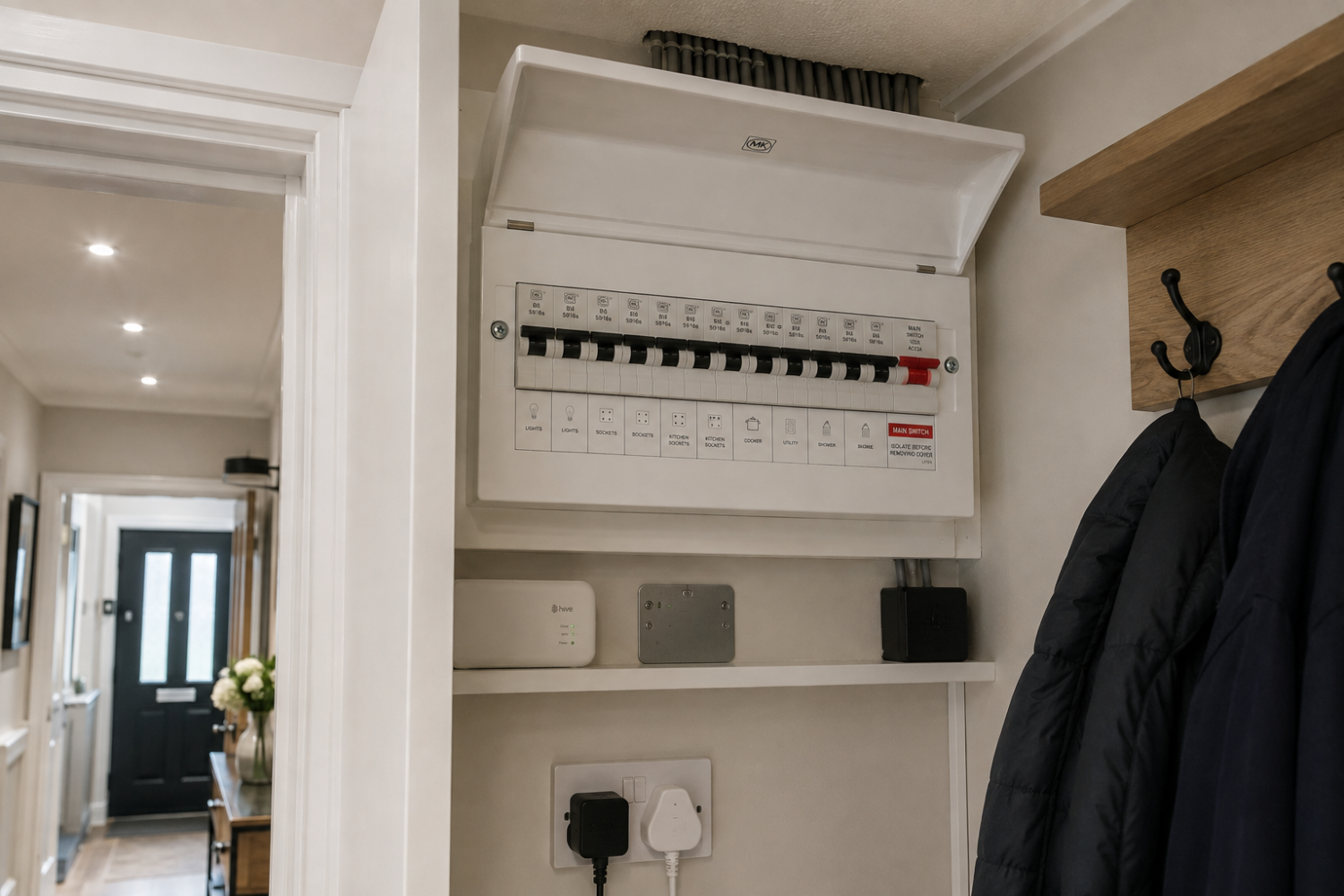
If you live in an older property, have recently bought a house, or simply do not know when the wiring was last replaced, you may be wondering whether your home needs rewiring.
The short answer is that age alone does not automatically mean a house needs a full rewire. What matters is the condition of the wiring, how the installation has been altered over the years, the level of electrical protection in place, and whether the system is suitable for the way you now use your home.
Some older installations remain serviceable, while others may have deteriorated wiring, outdated protection or years of additions that make further upgrades difficult.
For homeowners across Horley, Reigate, Redhill, Crawley, Surrey and West Sussex, the best way to find out is through a proper electrical inspection rather than relying on appearance alone.
How Do You Know If a House Needs Rewiring?
You cannot reliably tell whether a property needs rewiring simply by looking at the sockets or consumer unit.
Much of the electrical installation is hidden inside walls, floors and ceilings. A property may have modern-looking sockets while older wiring remains behind them.
An electrician will normally consider the overall condition of the installation, including the cables, consumer unit, earthing, protective devices, circuits and any alterations that have been made.
There are, however, some warning signs that should encourage you to have the electrics checked.
These include:
- Regularly tripping circuits
- Flickering or dimming lights
- Buzzing or crackling from switches or sockets
- Discoloured, cracked or damaged accessories
- Burning smells around electrical equipment
- Very old-style fuse boxes
- A lack of RCD protection
- Old or deteriorated wiring
- Numerous extensions or alterations carried out over many years
- Too few sockets for the way the property is used
- Extension leads being relied on throughout the home
These signs do not automatically mean a full house rewire is required, but they do justify professional investigation.
If you notice burning smells, significant heat, smoke or visible electrical damage, stop using the affected equipment or circuit and contact an electrician promptly.
How Old Does Wiring Have to Be Before It Needs Replacing?
There is no fixed age at which electrical wiring suddenly becomes unsafe.
Wiring does not normally need replacing simply because it reaches a particular birthday. Its condition depends on factors such as the original installation, cable type, environmental conditions, previous alterations and how heavily the electrical system has been used.
A well-installed system may continue operating safely for many years.
The difficulty with older homes is that the electrical installation may have been changed repeatedly.
A house in Reigate or Redhill, for example, might have original circuits from one period, an extension wired decades later, a newer kitchen circuit and a more recent consumer unit. That can leave you with a mixture of different ages and standards throughout one property.
This is why testing is more useful than guessing based on the age of the building.
What Does Old Electrical Wiring Look Like?
Some older wiring systems have characteristics that electricians recognise immediately, but homeowners should not remove sockets, switches or consumer unit covers to investigate them.
You may notice clues such as an older fuse box, outdated accessories or visibly aged cables in accessible areas.
Older properties can sometimes contain rubber-insulated, fabric-covered or other historic cable types that have deteriorated with age.
However, modern-looking accessories do not prove that the wiring behind them has been replaced.
Someone may have changed the sockets and switches without replacing the cables.
If there is uncertainty, proper electrical testing can establish far more than appearance alone.
Does an Old Fuse Box Mean You Need a Rewire?
Not necessarily.
An old fuse box can indicate that the electrical installation has not had a major upgrade for some time, but replacing a consumer unit and rewiring an entire property are two different jobs.
Modern consumer units provide considerably more sophisticated protection than older fuse boxes.
Depending on the installation, this can include RCDs, or residual current devices, which rapidly disconnect the electricity when certain electrical faults occur.
Many modern installations also use RCBOs, which combine circuit-breaker and residual-current protection for individual circuits.
If your fuse box is outdated, an electrician may recommend replacing it. However, the existing circuits should normally be assessed and tested before deciding whether they can safely remain in service.
Sometimes a consumer unit upgrade is all that is required.
In other properties, testing reveals issues with the circuits themselves that require repair, partial rewiring or more extensive replacement.
What Is the Difference Between a Partial Rewire and a Full Rewire?
A full rewire normally involves replacing most or all of the fixed electrical wiring within the property and creating a new installation designed around the building’s current requirements.
A partial rewire means replacing specific circuits or sections while retaining other parts that remain suitable.
For example, you may have an older property where the upstairs lighting circuit needs replacing but newer kitchen and socket circuits remain in good condition.
Alternatively, an extension may already have relatively modern electrics while the original part of the house requires upgrading.
A competent electrician should not recommend a full rewire simply because one part of the installation has a problem.
The decision should be based on inspection, testing and the practical condition of the entire system.
Can an EICR Tell You If Your House Needs Rewiring?
An Electrical Installation Condition Report, usually shortened to EICR, is one of the best ways to understand the condition of an existing electrical installation.
An EICR involves inspecting and electrically testing the fixed wiring and associated equipment.
The electrician will assess areas such as:
- Consumer units
- Electrical circuits
- Earthing and bonding
- Sockets and switches
- Lighting circuits
- Protective devices
- Signs of damage or deterioration
- Electrical alterations
- Circuit safety and performance
The results are recorded in a report.
An EICR does not automatically result in a recommendation for rewiring. Quite often, an inspection identifies individual repairs or improvements instead.
Where serious deterioration or widespread problems are found, the electrician may recommend replacing affected circuits or carrying out a more extensive rewire.
JPEC Electrical already provides inspection and testing services throughout Surrey and West Sussex, so this can be a practical starting point if you are unsure about the condition of a property.
Do You Need to Rewire a House When You Buy It?
Buying an older house does not automatically mean you need to rewire it.
However, it is sensible to understand the condition of the electrical installation before planning major decoration or refurbishment.
Electrical condition is not always covered in detail by a standard property survey.
If there is no recent electrical documentation available, arranging an electrical inspection can help you understand what you are buying.
This can be particularly useful if:
- The house is older
- The electrical history is unknown
- You are planning major renovations
- The fuse board appears outdated
- There have been several extensions or alterations
- You want to install high-demand electrical equipment
Knowing about electrical work before decorating can also prevent the frustration of finishing a property and then discovering that walls and ceilings need disturbing for electrical upgrades.
Should You Rewire Before Renovating a House?
If you already know significant electrical work is required, it normally makes sense to deal with it early in a refurbishment.
A full rewire can involve lifting floorboards, accessing ceilings, cutting cable routes and working around walls.
Doing this after plastering, decorating or installing expensive finishes can create unnecessary additional work.
Renovation is also a useful opportunity to reconsider how you actually want to use the property.
Instead of simply replacing old cables in the same positions, you can plan:
- Additional socket outlets
- Dedicated kitchen circuits
- Better lighting layouts
- Outdoor electrics
- Home office supplies
- Electric heating
- EV charging
- Future renewable energy equipment
- Garden rooms or outbuildings
A properly designed electrical installation should account for both your current requirements and reasonable future demand.
Are There Enough Circuits and Sockets in Older Homes?
One common problem with older electrical installations is not necessarily that they have failed, but that they were never designed for modern lifestyles.
Homes now contain considerably more electrical equipment than many properties did when they were originally wired.
Televisions, computers, kitchen appliances, chargers, home office equipment, electric heating, EV chargers and other devices all place demands on an installation.
If you constantly rely on extension leads or multi-way adapters because there are not enough sockets, this may be a sign that the electrical layout needs reviewing.
That does not automatically require rewiring the whole house.
New circuits or additional outlets may sometimes be installed while retaining suitable existing wiring.
Does Repeated Tripping Mean the Wiring Is Bad?
Repeated tripping should be investigated, but it does not necessarily mean your entire electrical system has failed.
Protective devices can trip because of:
- A faulty appliance
- Damaged wiring
- Water entering electrical equipment
- An overloaded circuit
- Faulty outdoor equipment
- Insulation breakdown
- A problem with a particular circuit
If a circuit repeatedly trips after being reset, simply continuing to switch it back on is not the answer.
The purpose of the protective device is to disconnect the electricity when it detects certain abnormal conditions.
An electrician can test the circuit and identify whether the problem is a localised fault or part of a wider issue with the installation.
What Happens During a House Rewire?
The precise process depends on the property, but a typical rewire begins with assessing the existing installation and planning the new electrical layout.
The electrician will determine the required circuits, socket positions, lighting points, consumer unit arrangements and any specialist electrical supplies.
Old circuits are then disconnected as required and new cables are installed throughout the property.
This can involve access beneath floors, above ceilings and within walls.
Once the installation is complete, the circuits must be inspected and tested before being put into service.
Electrical installation work should comply with the relevant requirements of BS 7671, commonly known as the IET Wiring Regulations.
As of August 2026, the IET confirms that BS 7671:2018+A4:2026 has been published, while installations may continue to be designed to the previous Brown Book requirements incorporating Amendment 3:2024 until 15 October 2026.
For domestic electrical work in England, certain work is also covered by Part P of the Building Regulations, which deals with electrical safety in dwellings.
JPEC Electrical provides full and partial rewiring and electrical installation work, with its own service information confirming that this work is undertaken in accordance with applicable Building Regulations requirements.
How Disruptive Is Rewiring a House?
A full rewire is one of the more disruptive electrical jobs you can carry out in an existing home.
The level of disruption depends heavily on how the property is constructed and whether it is occupied.
Access may be needed to:
- Floors
- Walls
- Ceiling spaces
- Loft areas
- Existing cable routes
- Socket and switch positions
Decorative finishes may need making good afterwards.
The job can often be easier in an empty property or while other renovation work is taking place.
For occupied homes, planning becomes particularly important. Your electrician should explain which rooms will be affected, what furniture needs moving and when electrical supplies will be unavailable.
Will You Be Without Electricity During a Rewire?
There will normally be periods when electrical supplies need to be isolated so work and testing can be completed safely.
Whether the entire property needs to be without electricity at once depends on the project and how the work is phased.
On larger projects, an electrician may be able to organise the installation so that disruption is reduced.
However, electrical work should never be rushed simply to avoid switching the power off.
Safe isolation and proper testing are essential parts of electrical installation work.
How Much Does a House Rewire Cost?
There is no meaningful single price for rewiring every house.
Two properties with the same number of bedrooms can require very different amounts of work.
Factors affecting the price include:
- Property size
- Number of circuits
- Number of sockets and lighting points
- Whether the property is occupied
- Ease of access
- Construction type
- Existing wiring condition
- Consumer unit requirements
- Kitchen and bathroom requirements
- Outdoor electrics
- Specialist equipment
- Decorative making good
- Smart controls or additional technology
The best approach is to have the property assessed and receive a quotation based on the actual installation.
Very low rewire quotes should be considered carefully if they do not clearly explain what is included.
Electrical testing, certification, circuit design and appropriate protective equipment are all important parts of the work, not optional extras.
Do Landlords Need to Rewire Rental Properties?
Landlords do not automatically need to rewire a property simply because it is rented.
They do, however, have specific responsibilities for electrical safety.
In England, landlords covered by the current electrical safety regulations must have electrical installations inspected and tested by a qualified person at least every five years, with a report provided and necessary remedial work dealt with.
The rules were extended in 2025 to include the social rented sector as well as private rented properties.
An unsatisfactory EICR does not always mean a full rewire is necessary.
The report may identify a relatively small number of faults that can be corrected individually.
Where widespread deterioration is identified, more extensive rewiring may be appropriate.
For landlords and property managers around Horley, Crawley, Reigate and Redhill, maintaining proper inspection and repair records also makes it much easier to understand how the installation has changed over time.
Does an Old Consumer Unit Have to Be Replaced?
An older consumer unit is not automatically unsafe simply because newer equipment is now available.
Electrical standards develop over time, so an existing installation will not necessarily contain every feature included in a brand-new installation.
What matters is whether the installation is safe for continued use and whether any deficiencies have been identified through inspection.
This is another reason why automatically replacing equipment based purely on age can be misleading.
Testing should determine what genuinely needs attention.
Should You Rewire Before Installing an EV Charger or Other High-Power Equipment?
Not necessarily, but the existing electrical installation should be assessed before significant additional loads are introduced.
An EV charger, electric heating system, large appliance or other substantial electrical load may reveal limitations in an older installation.
An electrician may assess factors including:
- Existing consumer unit capacity
- Circuit protection
- Earthing arrangements
- Available electrical supply
- Existing cable condition
- Suitable routes for new circuits
Sometimes the correct solution is simply installing a properly designed dedicated circuit.
In other situations, older equipment or parts of the installation may need upgrading first.
Is Partial Rewiring Worth Doing?
Absolutely, where it is technically appropriate.
There is little benefit in replacing safe, serviceable wiring purely for the sake of saying the entire house has been rewired.
If inspection and testing confirm that certain circuits remain in suitable condition, a partial rewire may offer a more proportionate solution.
For example, you might replace:
- An ageing lighting circuit
- Wiring within an older extension
- Damaged kitchen circuits
- Unsafe DIY alterations
- A deteriorated outdoor supply
while retaining other circuits that test satisfactorily.
The important point is that the decision should come from evidence gathered during testing rather than assumptions.
When Should You Call an Electrician?
You should consider arranging an electrical assessment if:
- You do not know when the wiring was last inspected
- You have recently purchased an older house
- You are preparing for a major renovation
- Circuits regularly trip
- Lights flicker or behave unusually
- Sockets or switches appear damaged
- You have an older fuse box and are unsure about its condition
- You are planning significant electrical additions
- You have concerns about previous DIY electrical work
- You are a landlord and need to meet electrical inspection requirements
If there are signs of burning, overheating, smoke, exposed conductors or other immediate electrical danger, avoid using the affected equipment and seek professional help.
House Rewiring Across Surrey and West Sussex
Properties throughout Surrey and West Sussex vary enormously in age and construction.
A period property in Reigate may present completely different electrical challenges from a modern home in Crawley or a commercial conversion around Horley.
That is why electrical recommendations should be based on the individual property rather than a generic assumption about age.
JPEC Electrical works with domestic, commercial, industrial and agricultural customers throughout the South East and provides electrical installation, inspection, testing and emergency services.
JPEC Electrical Can Help
If you are unsure whether your home needs rewiring, JPEC Electrical can inspect and test the existing installation before recommending what actually needs to be done.
Depending on the condition of the property, that may involve targeted repairs, a consumer unit upgrade, new circuits, a partial rewire or a complete electrical rewire.
JPEC Electrical provides electrical installation, rewiring, inspection, testing and fault-finding services for homes and businesses across Horley, Reigate, Redhill, Crawley, Surrey, West Sussex and the wider South East.
If you are buying an older property, planning renovations or simply want to understand the condition of your electrics, get in touch with JPEC Electrical to arrange an assessment or quotation.
This guide provides general information only. Every electrical installation is different, and any recommendation to repair, upgrade or rewire should be based on a proper inspection and assessment of the individual property.