
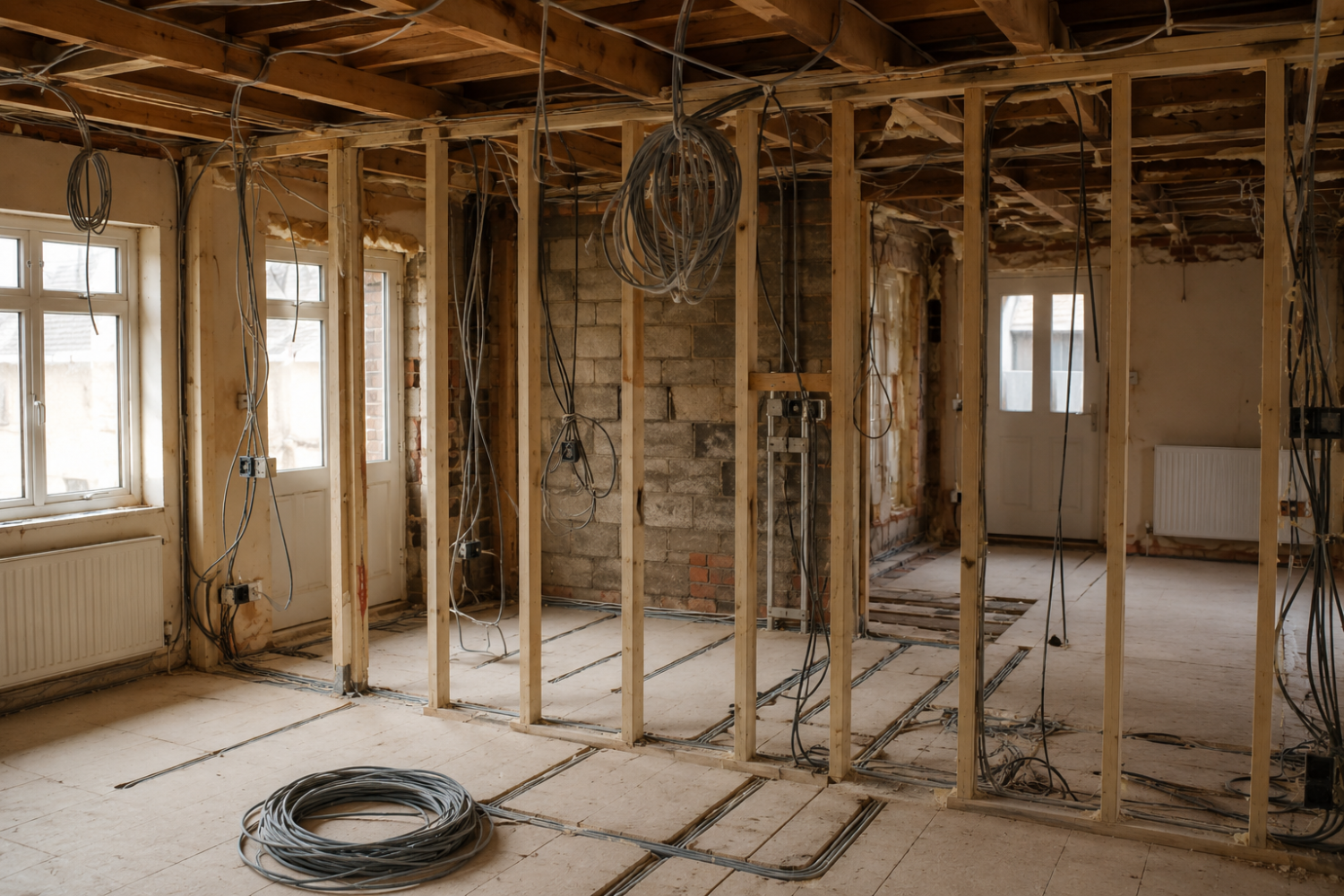
Your house may need rewiring if the electrical installation is damaged, deteriorated, frequently causing problems or no longer suitable for the way the property uses electricity.
Warning signs can include regularly tripping circuits, burning smells, damaged sockets, flickering lights, discoloured accessories and older wiring that has not been inspected for many years.
However, the age of a property does not automatically determine whether it needs rewiring. The condition of the wiring must be assessed through a professional electrical inspection and testing.
JPEC Electrical provides electrical inspections, house rewiring, partial rewiring and electrical installation upgrades throughout Horley, Reigate, Redhill, Crawley, Surrey, West Sussex and the wider South East.
What Does Rewiring a House Involve?
Rewiring involves replacing some or all of the fixed electrical wiring within a property.
Depending on the condition of the installation and the requirements of the homeowner, the work may include replacing or upgrading:
- Electrical cables
- Socket circuits
- Lighting circuits
- Switches and socket outlets
- The consumer unit
- Earthing and bonding
- Cooker and kitchen circuits
- Electric shower circuits
- Smoke alarm supplies
- Outdoor electrical supplies
- Wiring for extensions or loft conversions
A full house rewire normally covers the entire electrical installation. A partial rewire focuses on specific rooms, circuits or areas where the existing wiring is unsuitable or defective.
The correct solution should be based on electrical test results, the condition of the installation and the future requirements of the property.
What Are the Signs That My House May Need Rewiring?
Electrical wiring is usually hidden beneath floors, inside walls and above ceilings. This can make it difficult for homeowners to see whether it is deteriorating.
There are several warning signs that should be investigated by a qualified electrician.
Circuits Keep Tripping
A circuit breaker or RCD may operate when it detects a fault, overload or leakage current.
Occasional tripping may be caused by a faulty appliance. However, circuits that repeatedly trip may indicate a problem with the fixed wiring, connected equipment or circuit design.
Do not repeatedly reset a circuit without investigating why it is operating.
Lights Flicker or Dim
Flickering lights can sometimes be caused by a loose lamp or faulty light fitting.
If several lights flicker, dim unexpectedly or change when appliances are switched on, the electrical installation should be inspected.
Sockets or Switches Feel Warm
Sockets, switches and electrical accessories should not normally become unusually hot during use.
Excessive heat, scorching or discolouration may indicate a loose connection, damaged accessory, overloaded circuit or another electrical fault.
Stop using an accessory if it shows signs of overheating and arrange an electrical inspection.
There Is a Burning Smell
A burning or hot-plastic smell near a socket, switch, light fitting or consumer unit should never be ignored.
Safely stop using the affected circuit or equipment where possible and contact a qualified electrician.
There Are Buzzing or Crackling Noises
Electrical accessories should not normally make buzzing, crackling or arcing noises.
Unusual sounds may indicate a loose connection or damaged component requiring urgent attention.
Sockets or Switches Are Damaged
Cracked sockets, loose switches, missing covers and exposed electrical parts can present a safety risk.
Replacing the visible accessory may solve the immediate problem, but the wiring behind it should also be assessed where damage or overheating is present.
There Are Too Few Sockets
Older properties were not designed for the number of electrical appliances commonly used in modern homes.
Heavy reliance on extension leads and multiway adapters may indicate that the existing electrical installation no longer provides enough socket outlets.
A rewire can be designed around how each room will actually be used, reducing the need for trailing extension cables.
The Wiring Has Been Altered Several Times
Properties that have been extended, converted or renovated by different owners may contain electrical work completed at different times.
This can result in:
- Mixed cable types
- Unclear circuit arrangements
- Poorly positioned junctions
- Inadequate protection
- Unlabelled circuits
- Unsafe DIY alterations
- Circuits that have been extended incorrectly
An Electrical Installation Condition Report can help establish the condition of the installation and identify areas requiring further investigation.
Does an Old House Automatically Need Rewiring?
An old house does not automatically need rewiring.
The decision should be based on the condition of the electrical installation rather than the age of the building alone. An older installation that has been properly maintained and produces satisfactory test results may not require complete replacement.
Similarly, a newer property could require remedial work if the wiring has been damaged or altered incorrectly.
The electrician should consider:
- The type and condition of the cables
- Electrical test results
- The condition of sockets and switches
- Earthing and bonding
- Consumer unit protection
- Previous alterations
- The number and design of circuits
- Current electrical demand
- Plans for future improvements
JPEC Electrical can carry out an electrical inspection before recommending a full or partial house rewire in Horley, Reigate, Redhill, Crawley or the surrounding areas.
What Types of Older Wiring Might Be Found?
The cable type and installation method can provide useful information about the approximate age and condition of an electrical installation.
Older properties may contain wiring or accessories that differ from those used in more recent installations.
Examples can include:
- Rubber-insulated cables
- Fabric-covered cables
- Older PVC wiring
- Rewireable fuse boxes
- Wooden-backed electrical accessories
- Limited earthing arrangements
- Older socket and lighting circuits
- Electrical additions from different periods
The presence of older equipment does not, by itself, prove that a complete rewire is necessary. Inspection and testing are required to determine its condition and continued suitability.
Should I Get an EICR Before Rewiring My House?
An Electrical Installation Condition Report, commonly called an EICR, can help determine the condition of a property’s fixed electrical installation.
The inspection may assess:
- Electrical wiring
- Socket and lighting circuits
- The consumer unit
- Protective devices
- Earthing and bonding
- Signs of deterioration
- Electrical test results
- Previous additions or alterations
The report records observations and highlights damage, defects, deterioration or conditions requiring further investigation.
An EICR does not automatically mean that a property needs rewiring. It provides evidence that helps a qualified electrician recommend appropriate remedial work.
Depending on the results, the solution may be:
- A small electrical repair
- Replacement of damaged accessories
- Upgrading earthing or bonding
- Adding suitable protection
- Replacing one circuit
- Completing a partial rewire
- Completing a full house rewire
JPEC Electrical provides EICRs and electrical inspections for homeowners, landlords, property managers and businesses across Surrey and West Sussex.
What Is the Difference Between a Full and Partial Rewire?
Full House Rewire
A full rewire involves replacing the electrical wiring throughout the property.
It may be recommended when the existing installation is extensively deteriorated, unsuitable, unsafe or cannot be economically upgraded through smaller repairs.
A full rewire also allows the electrical system to be designed around the homeowner’s present and future needs.
Partial House Rewire
A partial rewire involves replacing specific circuits or sections of the property.
This may be suitable where:
- Only part of the installation is defective
- An extension or loft conversion is being added
- A kitchen or bathroom is being renovated
- One circuit has failed electrical testing
- Part of the property has already been rewired
- A damaged cable route requires replacement
The electrician must consider how the new work will connect to and operate with the existing installation.
Can I Rewire One Room at a Time?
It may be possible to rewire a property in stages, but this should be planned carefully.
Completing one room at a time can sometimes reduce the immediate cost and disruption. However, it may also create additional labour if floors, ceilings or decorations must be disturbed repeatedly.
Before dividing the project into stages, the electrician should establish:
- The condition of the entire installation
- Which circuits require urgent work
- Whether circuits serve several rooms
- How new and existing wiring will connect
- Whether the consumer unit is suitable
- The most practical cable routes
- The homeowner’s renovation schedule
Where a property is already being refurbished, it may be more efficient to coordinate the electrical work with plastering, flooring, decorating and other building services.
As part of JPEC Group, JPEC Electrical can support projects requiring coordinated electrical and building-related services.
Is It Best to Rewire Before Decorating?
Where possible, rewiring should be completed before plastering, decorating or installing new flooring.
Electrical cables may need to be routed:
- Beneath floorboards
- Inside walls
- Above ceilings
- Through loft spaces
- Behind kitchen units
- Between floors
Although electricians aim to minimise damage, some access may be required to install cables safely.
Planning the rewire before decorating can prevent newly finished surfaces from needing to be disturbed.
For property renovations across Horley, Crawley, Reigate, Redhill, Surrey and West Sussex, early electrical planning can help reduce delays and unnecessary repeat work.
What Should Be Planned Before a House Rewire?
A house rewire is an opportunity to design the electrical installation around the property and its occupants.
Before work begins, consider:
- The number of sockets required in each room
- Television and data points
- Home-office equipment
- Kitchen appliance locations
- Indoor and outdoor lighting
- Electric heating
- Electric showers
- Smoke and heat alarms
- Security equipment
- Garden buildings
- Outdoor sockets
- Air-conditioning supplies
- Solar PV and battery storage
- Electric vehicle charging
- Future extensions or conversions
Thinking ahead can reduce the need for disruptive alterations later.
For example, a homeowner planning an EV charger or garden office may benefit from having the necessary capacity and cable routes considered during the rewire.
Do I Need a New Consumer Unit During a Rewire?
A full house rewire will commonly include a new or upgraded consumer unit designed to protect the new circuits.
The electrician should assess:
- The number of circuits
- The protective devices required
- RCD or RCBO protection
- Surge protection
- Available capacity
- Earthing arrangements
- Labelling and circuit identification
- Potential future additions
The consumer unit must be selected as part of the overall electrical design rather than treated as a separate box replacement.
Will Rewiring Improve Electrical Safety?
A correctly designed and installed rewire can address deteriorated wiring, damaged circuits, unsuitable accessories and inadequate protection.
It also allows the installation to be arranged more logically, with clearly identified circuits and socket outlets positioned to suit modern use.
However, electrical safety also depends on ongoing maintenance and the safe use of appliances after the work is complete.
Rewiring cannot prevent faults caused by damaged appliances, overloaded extension leads or equipment being used incorrectly.
How Disruptive Is a House Rewire?
Rewiring can be disruptive because much of the fixed wiring is concealed within the building.
The level of disruption will depend on:
- Whether the property is occupied
- The construction of the walls and floors
- The number of rooms
- Access to loft and floor spaces
- Whether the property is being renovated
- The number of electrical points
- The condition of the existing installation
- The amount of making good required
Furniture and personal belongings may need to be moved away from working areas. Electricity may also be unavailable in parts of the property while circuits are being replaced.
A professional electrical contractor should explain the programme of work before starting and keep the property as clean and organised as reasonably possible.
How Long Does It Take to Rewire a House?
There is no single timescale for rewiring every property.
The duration will depend on the property’s size, construction, occupancy and electrical requirements.
A small, empty property with straightforward access may take less time than a large occupied home with complex wiring, several floors or extensive electrical requirements.
The quotation and pre-start survey should establish:
- The expected programme
- Which rooms will be affected
- When power will be unavailable
- Whether the property can remain occupied
- What preparation is required
- Whether making good is included
- How additional work will be handled
Is House Rewiring Notifiable Under Building Regulations?
Rewiring a dwelling is generally treated as notifiable electrical work under Part P of the Building Regulations in England.
Using an appropriately registered electrical contractor can simplify the compliance and notification process. The completed electrical installation should also be inspected, tested and supported by the appropriate certification.
Keep all electrical certificates and Building Regulations documentation safely, as they may be required when selling, renting or carrying out future work on the property.
What Certification Should I Receive?
After a house rewire, you should receive the relevant electrical installation certification.
The documentation should record information about the completed work and the associated inspection and test results.
Depending on the project, you may also receive confirmation that the required Building Regulations notification has been completed.
These documents provide an important record for:
- Future electrical work
- Property sales
- Landlord records
- Insurance enquiries
- Renovation projects
- Future inspections
Can I Rewire My House Myself?
A house rewire is not a suitable DIY project.
The work requires electrical design, safe isolation, appropriate cable selection, circuit protection, installation methods, inspection, testing and certification.
Electrical circuits may appear to operate while still containing serious defects that cannot be identified without appropriate knowledge and test equipment.
Using a qualified and registered electrician helps ensure that the installation is designed, installed and tested correctly.
Choosing a House Rewiring Electrician
When choosing an electrician for a house rewire, ask for a clear written quotation explaining the proposed work.
Useful questions include:
- Will the existing installation be inspected first?
- Is the quotation for a full or partial rewire?
- How many sockets and lighting points are included?
- Is the consumer unit included?
- Will earthing and bonding be assessed?
- What electrical certification will be provided?
- Is Building Regulations notification included?
- Is making good included?
- How long is the work expected to take?
- Can the property remain occupied?
- How will additional work be agreed?
The cheapest quotation may not include the same number of electrical points, testing, certification, equipment or making good.
Make sure quotations are compared on a like-for-like basis.
House Rewiring in Horley, Reigate, Redhill and Crawley
JPEC Electrical provides professional electrical rewiring services for homes and properties throughout the South East.
Our areas include:
- Horley
- Reigate
- Redhill
- Crawley
- Horsham
- Haywards Heath
- Lingfield
- Oxted
- East Grinstead
- Surrey
- West Sussex
- Kent
- London and the wider South East
Whether you require a full house rewire in Horley, a partial rewire in Reigate, an EICR in Redhill or an electrical installation upgrade in Crawley, our electricians can assess the property and recommend an appropriate solution.
JPEC Electrical Can Help
JPEC Electrical provides complete electrical installation, inspection, testing and rewiring services for:
- Homeowners
- Landlords
- Letting agents
- Housing providers
- Builders and developers
- Commercial businesses
- Industrial premises
- Agricultural properties
- Local authorities and organisations
Our services include:
- Full house rewiring
- Partial rewiring
- Electrical Installation Condition Reports
- Consumer unit replacements
- Electrical fault finding
- Earthing and bonding upgrades
- New circuits
- Socket and lighting installations
- Electrical work for extensions and renovations
- Commercial electrical installations
From our head office in Horley, JPEC Electrical supports customers throughout Surrey, West Sussex, Kent, London and the wider South East.
If you are experiencing electrical problems, purchasing an older property or planning a major renovation, arranging an electrical inspection can help establish whether repairs, a partial rewire or a complete house rewire are required.
Contact JPEC Electrical to arrange an inspection or discuss your house rewiring requirements.
This article provides general information and is not a substitute for an electrical inspection or a design prepared for a specific property. Electrical recommendations should be confirmed by a competent electrician following appropriate inspection and testing.