
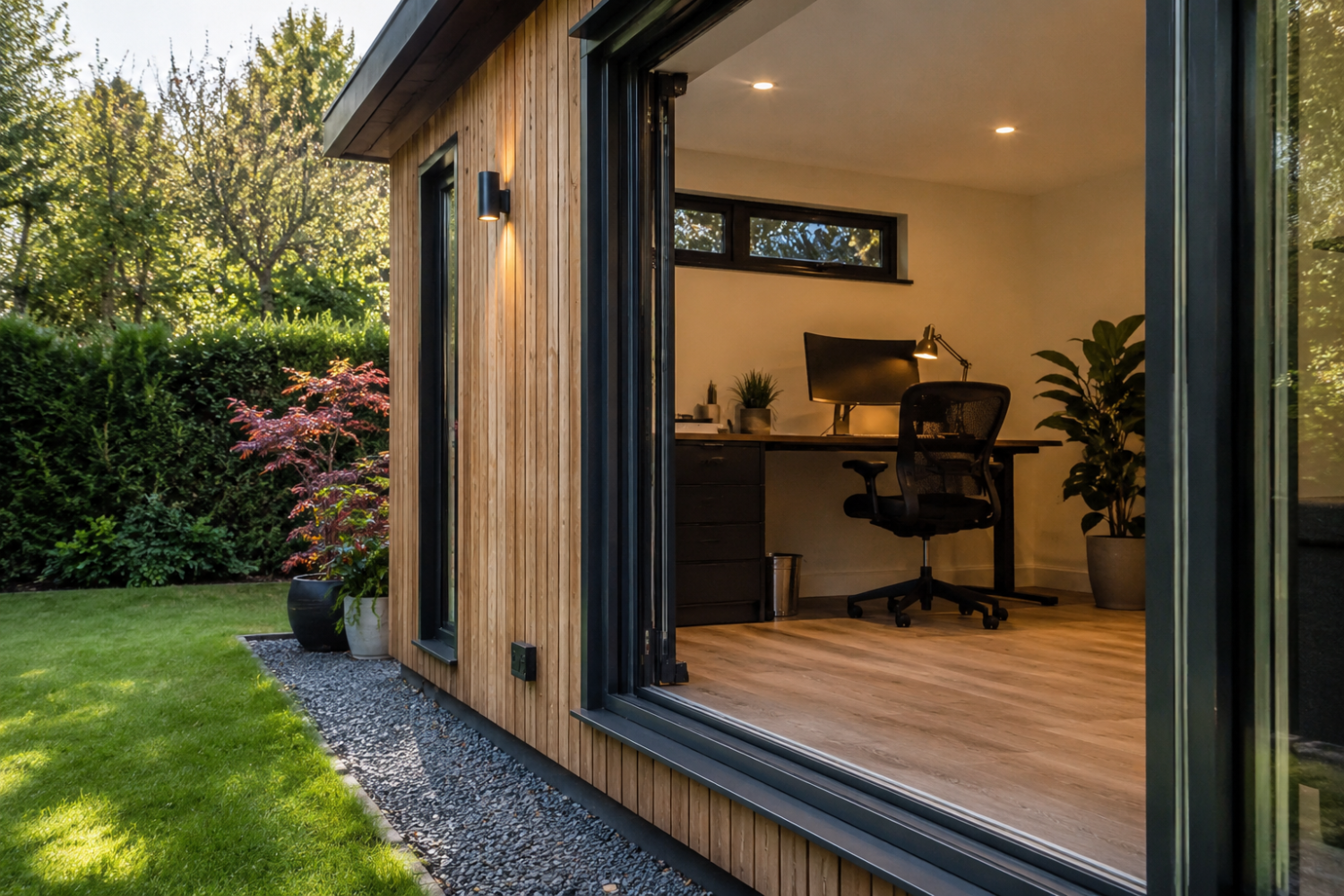
Garden rooms have become a popular way to create extra usable space without making major alterations to the main property. They can be used as home offices, gyms, workshops, treatment rooms, studios, entertainment spaces or simply somewhere quiet to relax.
However, a garden room will only be genuinely useful if its electrical installation has been planned properly.
Running an extension lead from the house is not a suitable permanent solution. A professionally designed power supply can provide reliable lighting, sockets, heating, internet equipment and other facilities while helping to protect the building and its users.
For homeowners and businesses in Horley, Reigate, Redhill, Crawley and surrounding areas of Surrey and West Sussex, arranging the electrics early can also prevent expensive alterations once the garden room has been completed.
What electrical work does a garden room need?
The requirements will depend on how you intend to use the building.
A simple summerhouse may only require lighting and one or two sockets. A garden office, beauty room, gym or workshop could place considerably more demand on the electrical supply.
A typical garden room electrical installation may include:
- Internal and external lighting
- Double sockets and USB charging points
- Electric heating or air conditioning
- Power for computers, televisions and internet equipment
- Outdoor sockets and garden lighting
- Supplies for tools, gym equipment or specialist machinery
It is important to discuss everything you may want to use before the installation is designed. Adding extra capacity during the initial installation is normally easier than altering a completed garden room later.
Can electricity be run safely to a garden room?
Yes. Electricity can be supplied safely to a detached garden room, but the route, cable type, electrical load and protective devices must all be considered.
A garden room will normally require a properly designed cable running from the main property. Depending on the installation, this may involve steel wire armoured cable, commonly referred to as SWA cable.
Armoured cable is designed to provide mechanical protection, but simply using armoured cable does not automatically make an installation safe. The electrician must also consider:
- The length and route of the cable
- How much power the garden room will require
- The condition and capacity of the existing consumer unit
- Voltage drop along the cable
- Earthing and bonding arrangements
- RCD or RCBO protection
- The depth and protection of any buried cable
- Whether future equipment may increase demand
The final design should be based on the actual installation rather than a standard cable size being used for every property.
Does a garden room need its own consumer unit?
Many garden rooms benefit from having a small consumer unit or distribution board inside the building.
This allows the sockets, lights, heating and other equipment to be divided into appropriate circuits. It can also make it easier to isolate a particular circuit without switching off everything in the garden room.
Whether a separate consumer unit is needed will depend on the size and intended use of the building. A small garden office may have very different requirements from a workshop containing high-powered tools or machinery.
An electrician should calculate the expected demand and design the installation accordingly.
Can my existing fuse box support a garden room?
Before installing a new power supply, the existing consumer unit—often still called a fuse box—should be assessed.
The electrician will need to determine whether it has sufficient capacity and whether the existing protective devices are suitable. They may also check the condition of the incoming supply, earthing arrangements and relevant parts of the existing wiring.
A consumer unit does not automatically need replacing simply because a garden room is being installed. However, additional work may be recommended if the existing equipment cannot safely support the new circuit or does not provide the required protection.
This assessment is especially important where the garden room will contain electric heating, air conditioning, exercise equipment or power tools.
Planning sockets and lighting
The position of sockets and lights should be agreed before the walls and internal finishes are completed.
Consider where desks, televisions, gym equipment, workbenches and furniture will be positioned. Installing enough sockets in useful locations reduces reliance on extension leads and overloaded adaptors.
For a garden office, it may be sensible to provide sockets around the desk area for:
- Computers and monitors
- Printers
- Phone chargers
- Internet routers or network equipment
- Desk lighting
- Electric heating or cooling equipment
Lighting should also suit the purpose of the room. An office may require bright, even lighting, while a studio or relaxation space may benefit from dimmable or zoned lighting.
External lighting can improve access and security, particularly during winter. It should be suitable for outdoor use and positioned so that paths, steps and entrances are clearly visible without causing unnecessary glare.
Heating a garden office or garden room
Electric heating is often the most practical option for a detached garden building, but it must be included in the electrical load calculation.
Portable heaters can draw a significant amount of power and are not always the most convenient long-term option. Depending on the construction and use of the room, alternatives may include:
- Wall-mounted electric panel heaters
- Electric underfloor heating
- Infrared heating
- Air conditioning with heating capability
Insulation is equally important. A poorly insulated garden room may be expensive and difficult to keep comfortable regardless of the heating system installed.
The electrical supply should be designed for the selected heating equipment rather than assuming that it can simply be plugged into any available socket.
Do garden room electrics need RCD protection?
Appropriate circuit protection is essential for electrical installations supplying outdoor buildings.
An RCD monitors the electrical current and disconnects the supply quickly when certain types of fault are detected. This can reduce the risk of serious electric shock. Outdoor sockets and equipment require particular care because they may be exposed to moisture, physical damage and changing weather conditions.
The electrician will determine the correct arrangement of RCDs, RCBOs and other protective devices for the installation.
Electrical Safety First advises that outdoor sockets used for equipment such as lawnmowers and hedge trimmers should have RCD protection. Any outdoor accessories must also be correctly selected and installed for their environment.
Can I run an extension lead to my garden office?
An extension lead may be useful for temporary, occasional use, but it should not be treated as a permanent power supply for a garden room.
Extension leads can be damaged by doors, windows, garden tools, moisture and general wear. They may also become overloaded when used for heaters, computers and other equipment at the same time.
You should not bury an ordinary extension lead, leave plug-and-socket connections exposed outdoors or attempt to create a permanent installation using equipment that was only designed for temporary use.
A fixed electrical supply offers a safer, more reliable and neater solution.
Does garden room electrical work need certification?
Electrical work in homes, gardens and outbuildings must comply with the relevant safety requirements. Approved Document P covers electrical safety in dwellings in England, while BS 7671 contains the requirements for electrical installations.
Depending on the type of work being completed, it may also be notifiable under the Building Regulations.
Once the installation has been completed, it should be inspected and tested. The appropriate electrical certificate should then be provided to confirm what work was carried out and record the test results.
Keeping this documentation can be important for future maintenance, insurance and property sales.
Warning signs with existing garden electrics
Existing electrics in sheds, garages and garden rooms should be checked if you notice:
- Sockets or switches becoming hot
- Circuit breakers or RCDs repeatedly tripping
- Flickering lights
- Damaged or exposed cables
- Water entering electrical fittings
- Buzzing, crackling or burning smells
- Extension leads being used as permanent wiring
Do not continue resetting a protective device if it repeatedly trips. The tripping could indicate a faulty appliance, damaged cable, moisture problem or another electrical fault that requires investigation.
Planning for future use
A garden room’s purpose often changes over time. A home office may later become a gym, workshop, treatment room or entertainment space.
Discussing possible future requirements can help the electrician design an installation that is easier to adapt. This could include allowing capacity for additional sockets, electric heating, air conditioning, security lighting, data cabling or outdoor power.
It may not be necessary to install every feature immediately, but thoughtful planning can reduce disruption and unnecessary cost later.
Garden room electricians in Horley, Reigate, Redhill and Crawley
JPEC Electrical can assess, design, install, inspect and test electrical supplies for garden rooms, garden offices, workshops, garages and other outbuildings.
We support domestic and commercial customers across Horley, Reigate, Redhill, Crawley, Surrey and West Sussex.
Before work begins, we can assess your existing consumer unit, discuss how the room will be used and design an installation around the expected electrical demand. This helps ensure the finished space is practical, reliable and suitable for both its current and potential future use.
Speak to JPEC Electrical
Whether you are planning a new garden office or need existing outbuilding electrics checked, professional advice at an early stage can prevent delays and costly alterations.
Contact JPEC Electrical to arrange an assessment for garden room electrics, outdoor sockets, lighting, power supplies or electrical fault finding in Horley, Reigate, Redhill, Crawley and the surrounding areas of Surrey and West Sussex.